

Park · Queens · ⭐ 9.7/10 · 10168 reviews · updated: 2026-08-04 20:07:33
Address: 4-44 47th Rd, Long Island City, NY 11101, United States
Gantry Plaza State Park — twelve acres of Long Island City waterfront under two black cranes
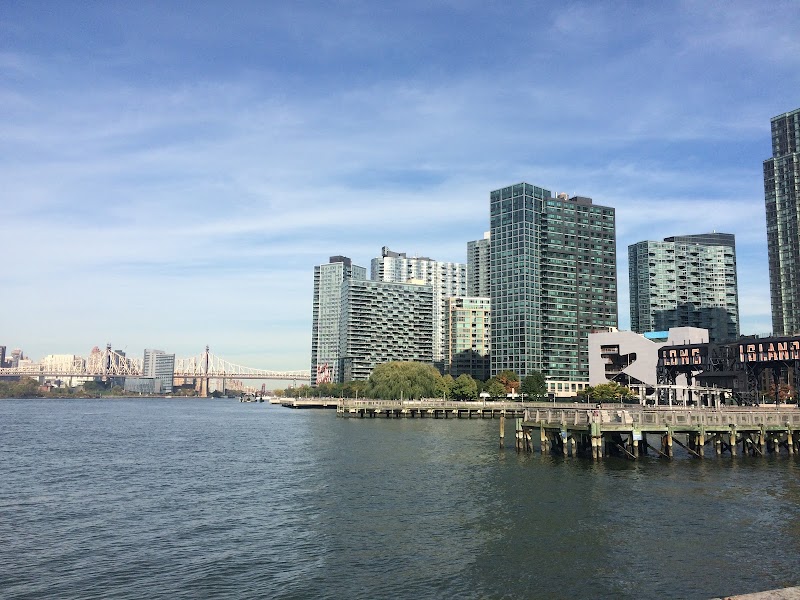
Two immense black steel gantries stand at the water’s edge in Hunters Point with the words LONG ISLAND lettered in red across their crossbeams, and behind them, close enough to feel like a stage backdrop, the whole of midtown Manhattan. This was a working freight yard where entire railroad cars were floated across the East River on barges; today it is a state park of twelve acres with four piers, gardens, a mist fountain and a landmarked neon Pepsi-Cola sign the size of a building. It is the shortest distance in New York between industrial archaeology and a postcard, and it is free.
Highlights
- The gantries — transfer bridges built in 1925 by the Long Island Rail Road to a patent design by James B. French, raised and lowered by pulleys through about eighteen feet to meet rail car floats as the tide moved. They handled cars weighing up to a hundred tons, worked until 1957, stood abandoned for four decades, and were restored and repainted black when the park opened.
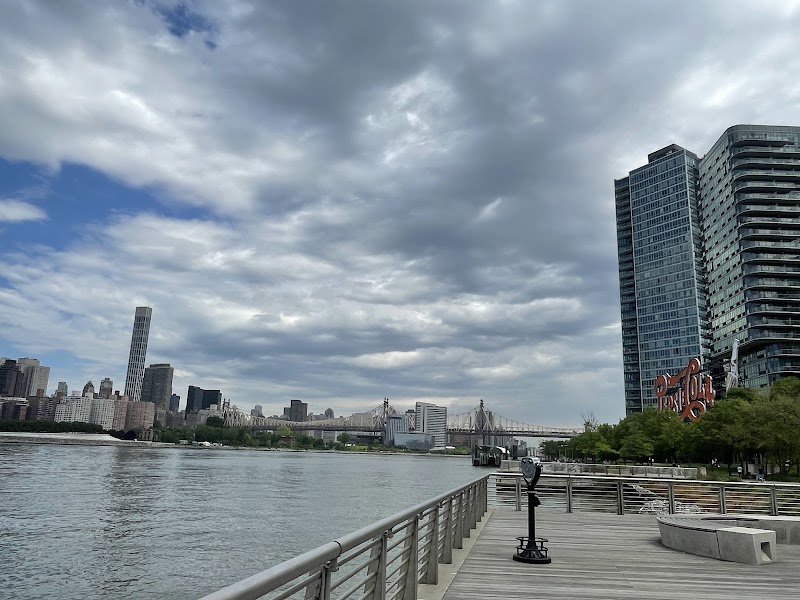
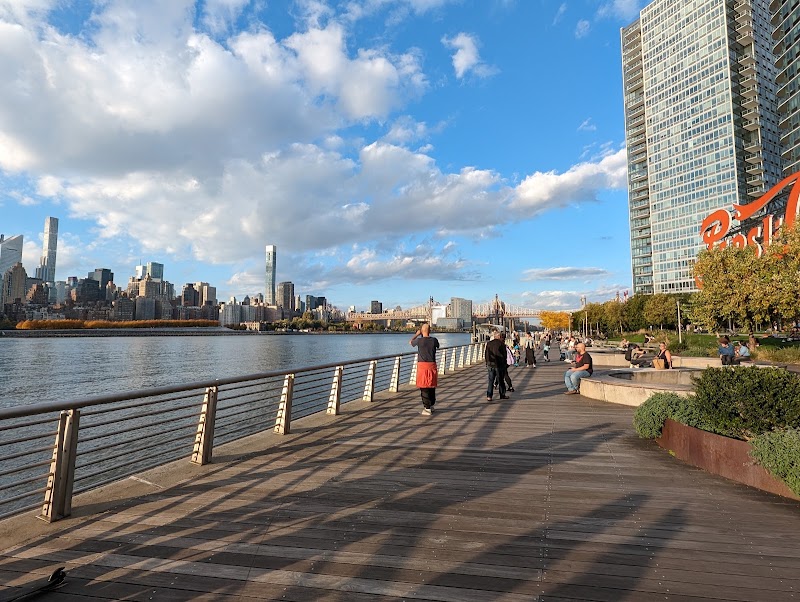
- The Pepsi-Cola sign — erected in 1940 on the roof of the Pepsi bottling plant that stood here, built by the General Outdoor Advertising Corporation and originally about 60 by 120 feet with a fifty-foot bottle. Nearly destroyed by a nor’easter in December 1992 and rebuilt by Artkraft Strauss, it was moved twice as the waterfront redeveloped and set in its present position in 2009. On April 12, 2016 it became a New York City landmark — the first individual sign ever designated.
- The four piers — each treated differently, with overlooks, seating and wooden decking projecting out over the river so you stand off the land entirely, with the skyline on three sides.
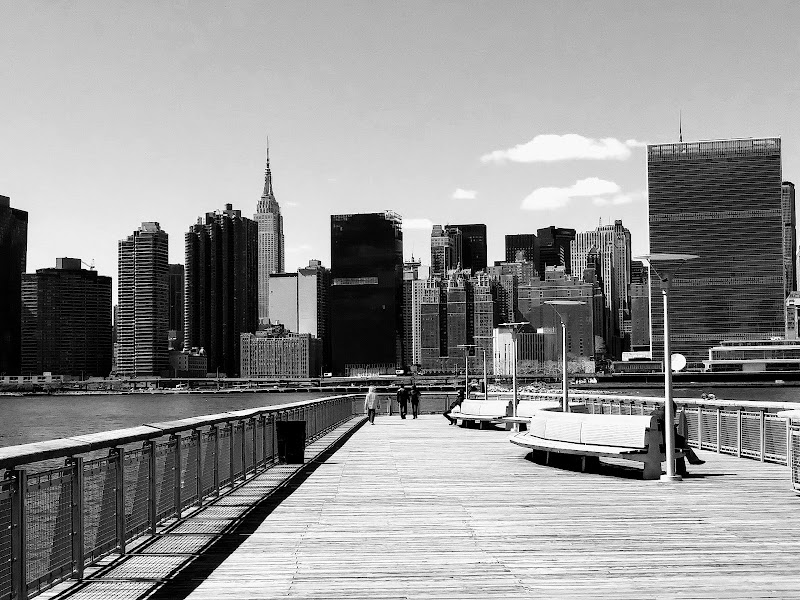
- The skyline view — the Empire State Building, the Chrysler Building and the United Nations headquarters sit almost directly opposite, which is why this stretch of railing is one of the most photographed spots in Queens.
- The mist fountain and gardens — planted terraces and a fountain that releases a low cloud of mist on warm days, a deliberately quiet counterpoint to the industrial hardware.
- The fishing pier — one pier is equipped for anglers, complete with a cleaning table, and the East River here holds striped bass and bluefish on the run.
What you’ll find
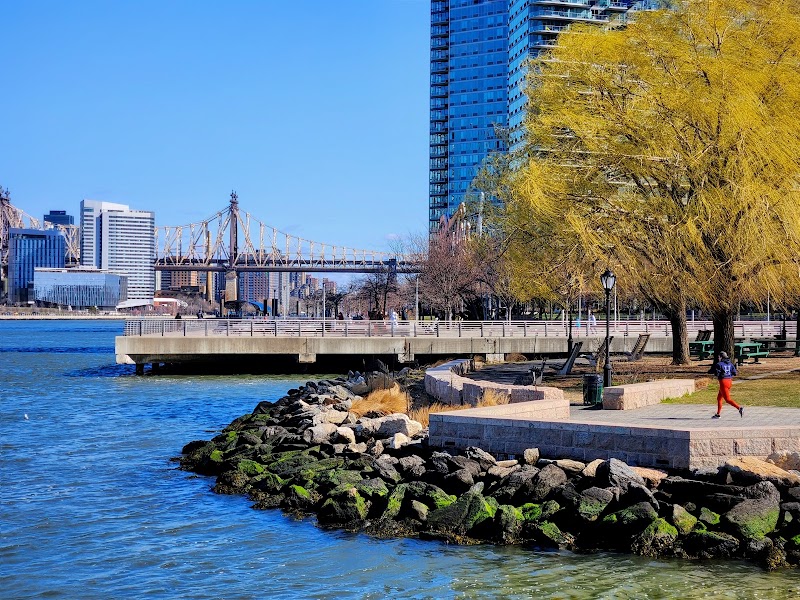
The park is long and narrow, a ribbon along the river rather than a green block, and it was designed in two campaigns: the original 1998 section by landscape architects Thomas Balsley and Lee Weintraub with architect Richard Sullivan, and the 2009 expansion by Abel Bainnson Butz. It runs straight into Hunter’s Point South Park next door, a city park that opened in phases in 2013 and 2018 with wetlands and a cantilevered viewing platform, so in practice you can walk a continuous waterfront for far longer than twelve acres suggests.
- A waterfront promenade the full length of the park, wide, flat and fully accessible.
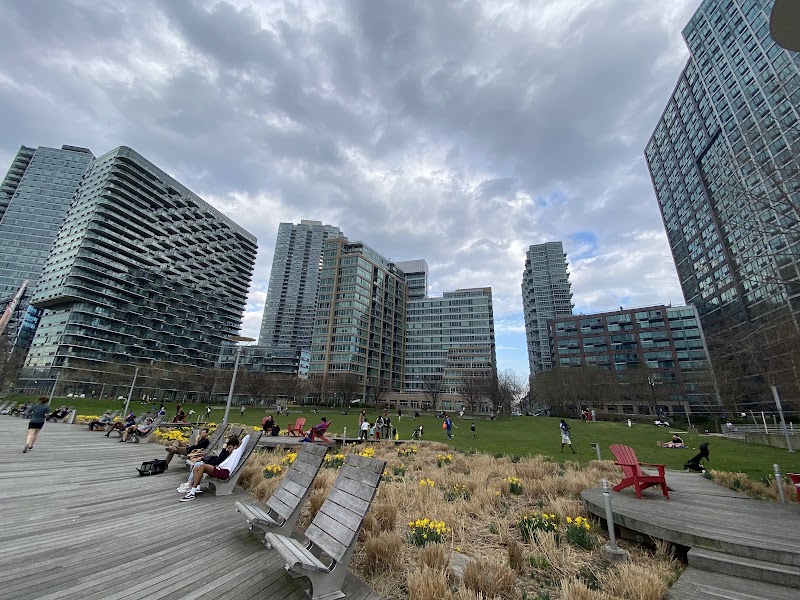
- Lawns and planted gardens between the promenade and the buildings, used hard on summer evenings.
- Basketball and handball courts, playing fields and a tot-lot playground for younger children.
- A seasonal spray pad, and two dog runs where off-leash play is allowed.
- Picnic tables — but note that grills and cooking of any kind are prohibited in the park at all times.
- Benches and sculptural seating angled deliberately at the skyline, including the well-known reclining loungers on the piers.
Things to do — and who it’s for
- Photographers — the single best accessible skyline vantage in Queens, with the gantries as foreground and the sun setting directly behind Manhattan.
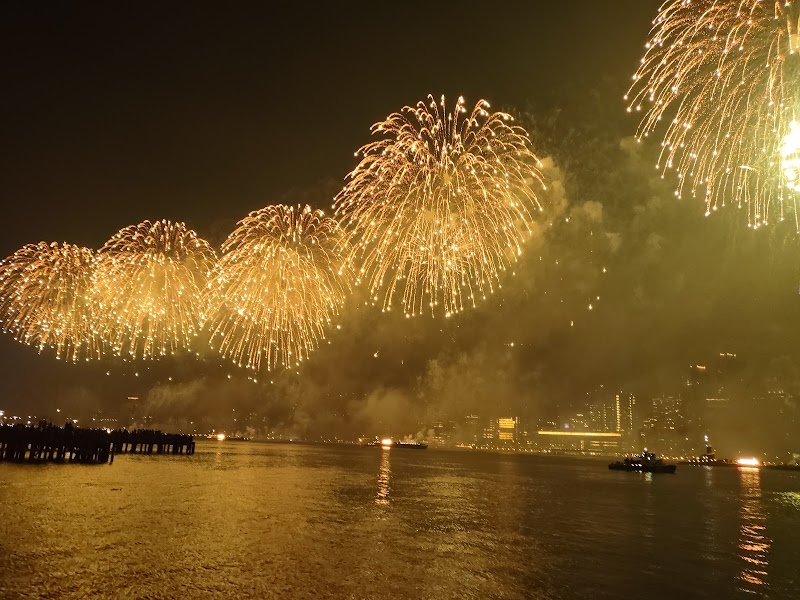
- Couples and evening visitors — pier seating, mist, low light and no admission cost make this one of the city’s most reliable free evenings out.
- Families with small children — a fenced tot lot, a summer spray pad and flat paved paths that work for strollers and scooters, all within sight of the water.
- Anglers — a dedicated fishing pier with a cleaning table, and a tidal river that runs seasonal saltwater species right past the railing.
- Dog owners — two dog runs, with clear rules: dogs stay on paved paths on leash outside the runs, and are kept off the lawns, gardens, piers and sports surfaces.
- Industrial history enthusiasts — a rare chance to stand under working-scale rail float infrastructure that survives in place rather than in a museum.
Getting there & practical
The park is in Hunters Point, at the western tip of Long Island City, and it is unusually well served for a waterfront strip. The 7 train stops at Vernon Boulevard–Jackson Avenue, a few minutes’ walk away; the G train stops at the 21st Street station a little further back; and the E and M reach Court Square, from which the whole neighborhood is walkable. NYC Ferry lands at the Long Island City stop immediately beside the park, served by the East River and Astoria routes, and arriving by boat is by far the best introduction. Entry is free — this is a state park, but there is no admission or vehicle charge here — and it is open daily from dawn to dusk, which in practice means the gates close earlier in winter than the skyline lighting deserves. Allow forty-five minutes to an hour for the park alone, or two to three hours if you continue along the waterfront into Hunter’s Point South Park and back. There is no parking to speak of; come by train or ferry.
When to visit
Spring brings the gardens back and the promenade dries out; the air over the river is still sharp, and the light after rain gives the cleanest views of the year. Summer is the park at its busiest and most social — the spray pad runs, the lawns fill in the evening, the ferries come and go every few minutes, and sunset lands late enough that you can eat first and still catch it. Autumn is the connoisseur’s season: the summer haze lifts, the skyline sharpens, sunset moves early enough for an after-work visit, and the crowds thin. Winter is stark and often superb — bare gardens, hard light, dusk arriving mid-afternoon, and the neon of the Pepsi sign burning against a blue-black river; dress properly, because there is no shelter from the wind coming across open water.
Good to know
Before the towers, this shoreline was one of the busiest freight interfaces in the region. The Long Island Rail Road had no freight tunnel into Manhattan, so entire railroad cars were rolled onto flat-bottomed barges called car floats and towed across the East River. Loading them required transfer bridges that could rise and fall with the tide, and the two double gantries here were built in 1925 to a patent design by James B. French, capable of moving four trains and cars weighing up to a hundred tons, each topped with a corrugated black metal control house. They worked until 1957, when trucking and tunnels finished the trade, and then stood rusting over a derelict shore for the better part of forty years. The state park that saved them opened in May 1998, designed by Thomas Balsley with Lee Weintraub and Richard Sullivan, and it was explicitly conceived as the anchor for the redevelopment of the whole Hunters Point waterfront — the towers came after the park, not before. An expansion designed by Abel Bainnson Butz opened in July 2009 and brought the total to twelve acres. The Pepsi-Cola sign has an equally industrial pedigree: it went up in 1940 above the Pepsi bottling plant on this shore, built by the General Outdoor Advertising Corporation at roughly 60 by 120 feet with a fifty-foot bottle in red and blue neon. A December 1992 nor’easter nearly finished it; Artkraft Strauss rebuilt it the following year. When PepsiCo closed the plant in 2003 the company stipulated that the sign must stay in Long Island City, and it was shifted south, then repositioned within the expanded park in 2009. On April 12, 2016 the Landmarks Preservation Commission designated it — the first individual sign in the city ever to receive that protection. Next door, Hunter’s Point South Park opened in phases in 2013 and 2018, adding constructed wetlands and a dramatic cantilevered overlook, so the two parks now read as one continuous public waterfront where a private freight yard used to be.
Visitor tips
- Arrive by NYC Ferry if you can. Coming in from the water gives you the gantries with the skyline behind them, which is the view the park was built around and one you cannot get from land.
- The park closes at dusk, so in winter you may lose the light before you lose access. Check sunset time and arrive around forty minutes beforehand to catch both the golden hour and the first neon.
- Do not plan a barbecue. Grills and cooking of any kind are banned here at all times, and dogs are restricted to leashed paved paths and the two dog runs — not the lawns, gardens or piers.
Questions & answers
Is Gantry Plaza State Park free? Yes. Despite being a New York State park, there is no admission charge and no vehicle fee here. It is open daily from dawn to dusk, and all the piers, promenades, gardens and playgrounds are free to use.
What are the gantries, exactly? They are transfer bridges, built in 1925 by the Long Island Rail Road to a patent design by James B. French. Pulleys raised and lowered them through about eighteen feet so that railroad cars could be rolled on and off barges as the tide changed. They operated until 1957 and were restored when the park opened in 1998.
Is the Pepsi-Cola sign the original one? It is the original sign in the sense that it dates from 1940 and has stood on this shoreline ever since, but it was substantially rebuilt by Artkraft Strauss after a nor’easter almost destroyed it in December 1992, and it has been moved twice, most recently into its present position in 2009.
What can you see from the park? Midtown Manhattan almost head-on: the Empire State Building, the Chrysler Building and the United Nations headquarters directly across the East River, plus river traffic, ferries and the sweep of the waterfront in both directions.
How do I get there without a car? Take the 7 train to Vernon Boulevard–Jackson Avenue, the G train to the 21st Street station, or the E or M to Court Square. NYC Ferry stops at Long Island City right beside the park on the East River and Astoria routes. Parking in the neighborhood is minimal, so transit is genuinely the better choice.
Can you fish here? Yes, from the designated fishing pier, which has a cleaning table. The East River is tidal saltwater at this point and carries seasonal runs of striped bass and bluefish. Standard New York State fishing regulations apply.
Are dogs allowed? Yes, with restrictions. There are two dog runs where dogs may be off leash. Elsewhere dogs must be leashed and kept to the paved paths, and they are not permitted on the lawns, in the gardens, on the piers or on the sports courts.
Can I barbecue or bring a grill? No. Cooking and grills of any kind are prohibited in the park at all times. Picnic tables are provided, so bring food already prepared.
How long should I allow? Forty-five minutes to an hour covers the park itself at an unhurried pace. Allow two to three hours if you walk on into the adjoining Hunter’s Point South Park, which opened in phases in 2013 and 2018 and continues the waterfront with wetlands and a cantilevered overlook.
Photos
Show 1 more photos
Visitor reviews
Reviews last updated: 2026-08-04 20:07:33
Data is refreshed monthly. Sources: queens.name and editorial picks based on reviews.
I drove past this park on my way to work in New York. There were a lot of people jogging, walking dogs and out with their kids. The park is spacious and the weather was mild, which made it perfect for a walk.
A beautiful urban oasis, easily reachable by public transit and on foot — we come from Astoria, Queens, on the N train to Queensboro Plaza and then walk the rest of the way through wonderful Long Island City, which has s…
A nice, wonderful park. Visiting Gantry Plaza Park felt healing, since there were far fewer people than in Manhattan. Another plus was the breathtaking view of the city skyline from the park. This place is definitely wor…
If I'm ever in that part of the world again, I'll definitely take another walk here 🙂 Recommend!
A cute park in Queens. Another park with breathtaking city views and no noise. Good transit access. The only downsides are that it's very crowded and it's a long walk (about 15 minutes) from the Vernon Blvd–Jackson Ave 7…