

Park · Queens · ⭐ 9.7/10 · 5554 reviews · updated: 2026-08-04 20:07:35
Address: Center Blvd, Long Island City, NY 11101, United States
Hunter’s Point South Park — a Long Island City waterfront built to let the water in
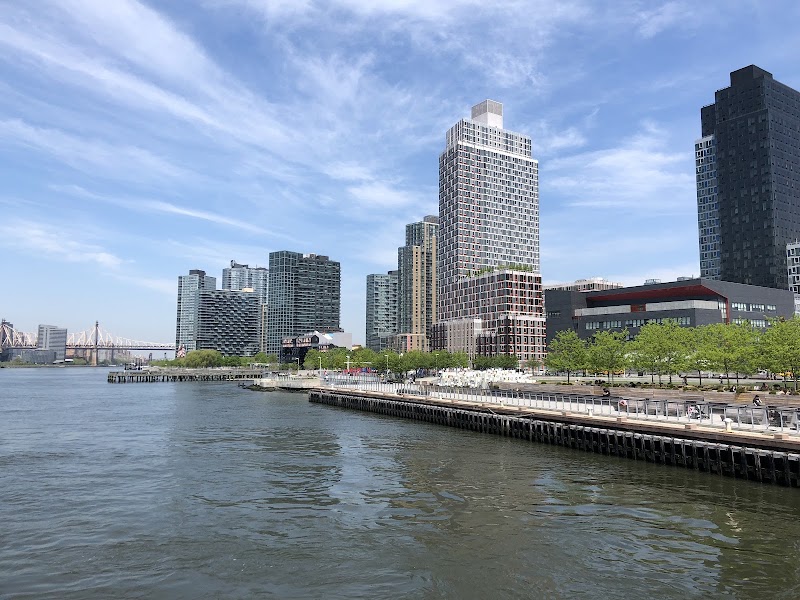
For most of a century this stretch of the Queens shoreline belonged to freight, not to people: a rail depot, a coal yard, a concrete plant, a newspaper printing works, and finally a fenced-off strip of fill where the Manhattan skyline stood just out of reach. Today it is one of the most quietly radical parks in New York — eleven acres of promenade, marsh, lawn and steel that were designed on the assumption that the East River will occasionally come ashore, and that the park should survive when it does. You walk out over restored tidal wetland on a platform that seems to float, you watch the light change on Midtown across the water, and underneath all of it sits a piece of coastal engineering disguised as a landscape.
Highlights
- The cantilevered overlook — a steel-and-wood platform that projects out from the southern end of the park and hangs above the marsh, roughly two storeys above the water, engineered so the deck reads as a slab floating free of any visible support.
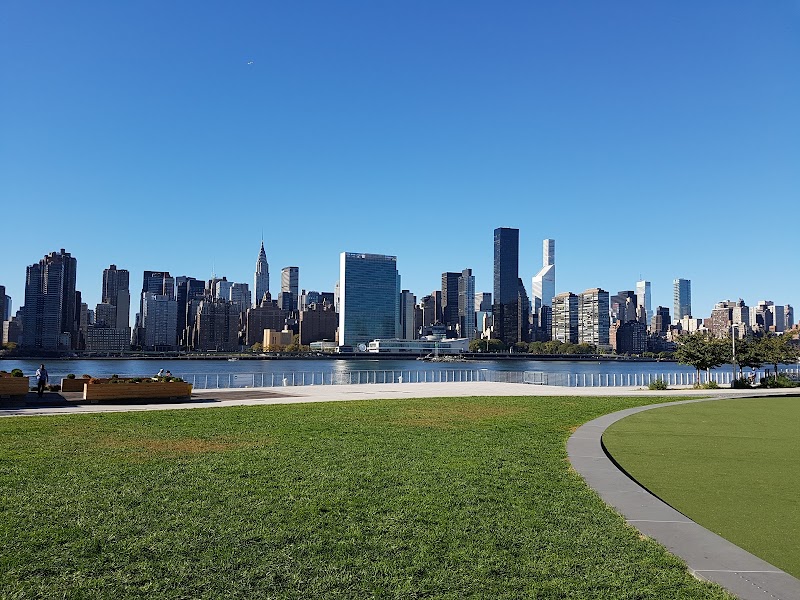
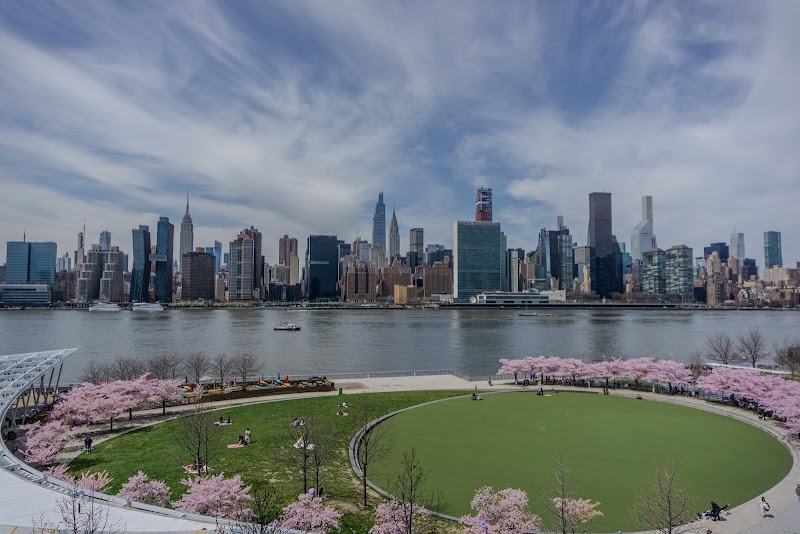
- The oval — a sunken synthetic-turf field ringed by broad concrete steps and a walking-and-running loop, deliberately set below grade so it can hold floodwater. During Hurricane Sandy in October 2012 it filled and drained without damage, which settled the argument about whether the idea worked.
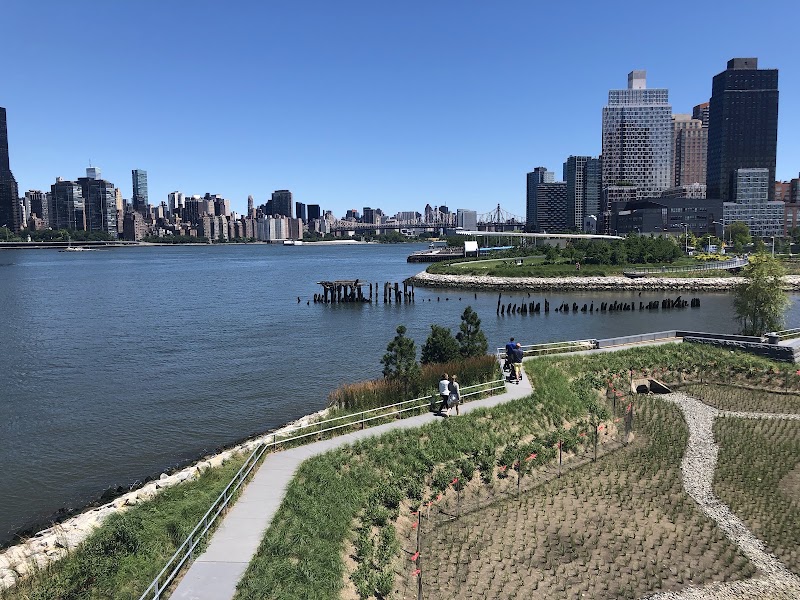
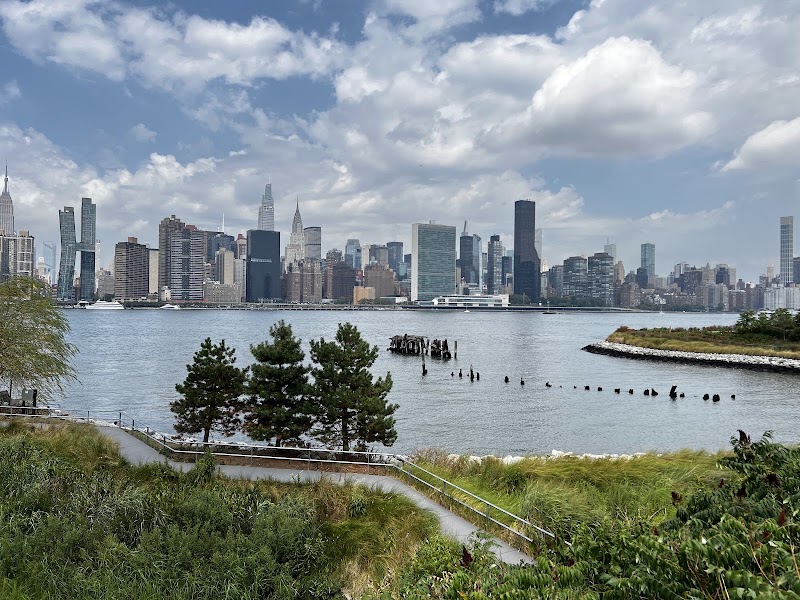
- The restored tidal wetland — nearly one and a half acres of low and high salt marsh built where an industrial concrete bulkhead used to be, planted with salt-tolerant natives and stabilising the shoreline instead of armouring it.
- “Luminescence” by Nobuho Nagasawa — seven low concrete domes shaped as phases of the moon, their surfaces modelled from NASA lunar topography data and cast with phosphorescent material so they charge in daylight and glow a soft blue after dark.
- The pavilion — a curved structure at the edge of the lawn that unfolds into a pleated steel canopy, giving shade, seating and a framed view straight across the river toward the Empire State Building.
- The island and the causeway — a meandering elevated walkway carries you just above the river, and a small pedestrian bridge crosses to a planted promontory that behaves like an island when the tide is high.
What you’ll find
The park reads as two connected landscapes. The northern half, opened first, is the sociable one — open lawn, hard courts, playground, café pavilion and a long railed promenade. The southern half, added later, is the ecological one — causeway, marsh, overlook, quiet timber alcoves tucked into planting. A continuous waterfront walk stitches them together, with the river on one side and the wetland on the other.
- An unbroken riverside promenade with railings, benches and stepped seating down toward the water.
- A children’s playground, basketball courts, a dog run and a small pebbled cove often called the park’s “urban beach”, meant for looking rather than swimming.
- A kayak launch used for seasonal community paddling programmes on the East River.
- Exercise and picnic terraces on the upper level, and secluded bench alcoves — “little rooms” — screened by shrubs along the southern path.
- Bioswales, gabion ledges and grades that quietly handle stormwater, plus native plantings including coastal little bluestem and purple coneflower chosen to tolerate brackish spray.
- Public art beyond the moon domes, including a sculptural piece set into the basketball courts and rotating temporary installations.
Things to do — and who it’s for
- Runners and walkers — the oval loop plus the waterfront promenade give a flat, uninterrupted circuit with the skyline as pacing motivation and no traffic to cross.
- Photographers and sunset-chasers — the overlook and the promenade face west across the East River, which makes this one of the most reliable golden-hour positions in Queens.
- Families with small children — playground, lawn, level paths and a café pavilion within sight of each other, so nobody has to go far.
- Birdwatchers and nature-curious visitors — the marsh draws waders and shorebirds into a view that also contains skyscrapers, which is the whole point of the design.
- Paddlers — the launch puts small boats onto a working tidal river within sight of Midtown; go with an organised session rather than alone.
- Anyone who reads or thinks outdoors — the timber alcoves along the southern walk are genuinely private, which is rare on a New York waterfront.
Getting there & practical
The park sits in Hunters Point, the southern edge of Long Island City, and is unusually easy to reach without a car. The 7 train’s Vernon Boulevard–Jackson Avenue station is the closest subway stop and a short walk inland; the G train at 21st Street–Van Alst is the alternative. NYC Ferry’s East River route calls at the Hunters Point South landing at the park’s northern end, which is the most enjoyable approach — you arrive at the water rather than at a corner. The Long Island Rail Road’s Long Island City terminal and the Q103 bus both serve the neighbourhood, and the waterfront greenway brings cyclists in from both directions. Entry is free and there is no gate; the park keeps standard city park hours, opening early in the morning and closing late at night, with the promenade lit after dark. Paths are level, ramped and wheelchair-friendly throughout, including the ramp up to the overlook. Restrooms and the café operate on a seasonal schedule, so in winter it is worth planning around that. Allow an hour to walk the full loop slowly, two if you stop.
When to visit
Summer is the park at full volume: the lawn fills, the café opens, the ferry runs frequently and the promenade stays busy until well after sunset, when the moon domes begin to glow. Autumn is arguably better — the marsh grasses turn bronze, the light across the river sharpens, migrating birds drop into the wetland, and the crowds thin. Winter strips the park back to its bones and rewards you for it: the skyline is at its clearest in cold air, the wind off the river is genuinely fierce on the overlook, and you may have the southern walk to yourself. Spring brings the marsh back to green, the tide lines become obvious again, and the exposed, wind-scoured feel of February gives way to something much softer by May.
Good to know
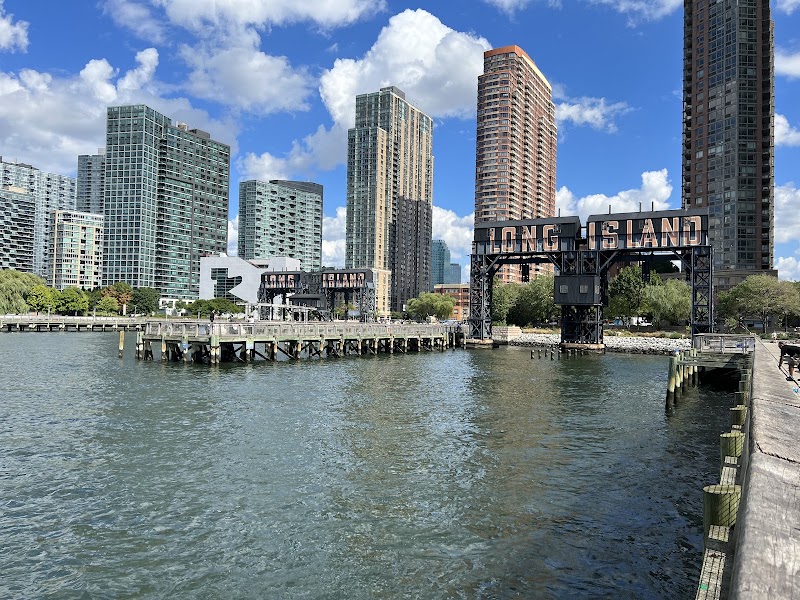
The name goes back to the mid-eighteenth century and to George Hunter, a Scottish immigrant whose family held land along the East River in what was then the Town of Newtown. A ferry linked the point to Manhattan by 1861, and industry followed fast: by the early twentieth century this waterfront was a working edge of piers, rail and fuel. In 1983 the wider area was folded into the Queens West redevelopment vision, and the modern park emerged from the Hunter’s Point South housing project that followed. It was built in two phases — the first, about five and a half acres, opened in August 2013 after breaking ground in January 2011; the second, of similar size, opened in June 2018 and added the wetland, the causeway, the island and the overlook. The design team paired the landscape architects of SWA/Balsley, led by Thomas Balsley, with the architects Weiss/Manfredi, and Arup as prime consultant and infrastructure designer. The work has since collected an ASLA National Honor Award, an AIA award for regional and urban design, and a ULI Americas Award for Excellence, largely because it demonstrated that flood defence could be built as public pleasure rather than as a wall. Immediately north lies Gantry Plaza State Park, with its restored rail gantries and the landmarked Pepsi-Cola sign — the two parks read as one continuous waterfront walk.
Visitor tips
- Come near sunset and stay past it: the moon domes need darkness to show what they do, and the skyline lighting-up is the best free show on this shoreline.
- Check the tide if the wetland is what you came for — at high water the marsh channels fill and the island genuinely looks like an island; at low water you see the structure of the planting instead.
- Bring a windproof layer even in mild weather. The overlook is exposed on three sides and the river wind is consistently stronger than the forecast for inland Queens suggests.
Questions & answers
Is there an admission charge? No. Hunter’s Point South Park is a free public park with no gates and no ticketing, and every part of it — including the overlook and the wetland walk — is open to everyone.
Can you swim there? No. The pebbled cove is often called an urban beach, but swimming in the East River is not permitted here; it is a tidal strait with strong currents and heavy vessel traffic. Use it as a place to sit at the water’s edge.
Is the park wheelchair accessible? Yes. The promenade, the causeway and the ramped approach to the cantilevered overlook are all step-free, and the main circulation routes are wide, smooth and gently graded.
Can I bring a dog? Yes. There is a dedicated dog run in the northern half, and dogs are welcome elsewhere on lead. Please keep them out of the restored marsh — the planting is doing structural work on the shoreline.
What is the best way to arrive? By NYC Ferry if you can time it. The East River route lands at the park itself, so you step off the boat directly into the landscape; the 7 train to Vernon Boulevard–Jackson Avenue is the fastest all-weather alternative.
Where does the park’s flood design actually show? In the shapes. The sunken oval is a basin, the stepped concrete edges are overflow storage, the gabion ledges and bioswales slow and filter runoff, and the soft marsh edge absorbs wave energy that a bulkhead would simply reflect.
Is it good for children? Very. The playground, open lawn, level paths and short distances make it easy to supervise, and the moon domes are the kind of object children invent games around without being told to.
Can I get food and drink in the park? Seasonally, yes — the pavilion houses a café and the ferry landing area has its own kiosk, both running on warm-weather schedules. Out of season, bring what you need from the restaurants a few minutes inland.
Photos
Show 1 more photos
Visitor reviews
Reviews last updated: 2026-08-04 20:07:35
Data is refreshed monthly. Sources: queens.name and editorial picks based on reviews.
One of the best places to watch the sunset in New York.
Beautiful views of the Manhattan skyline, a peaceful waterfront, and plenty of space to relax. As the city lights come on, the atmosphere becomes truly magical.
(Перекладено Google) Скрізь є дитячі майданчики, а також столики, де можна сісти та перекусити. Легко дістатися поромом до Манхеттена чи Брукліна. Це дуже зручно для сімейного відпочинку, а люди надзвичайно доброзичливі.…
Приїхав сюди, щоб помилуватися заходом сонця та тюльпанами. Виявляється, це місце відремонтоване, і тут є багато веселих місць, де можна відпочити. У них навіть є пляж для волейболу, бар і великий парк, де можна пограти.…
Яке ж гарне місце! Я вперше відвідав Південний парк Хантерс-Пойнт, і мені там дуже сподобалося. Парк просторий і жвавий, особливо дитячий майданчик, де діти насолоджуються своїм часом. Мальовничі доріжки в поєднанні з пр…
Набережна Квінзу зроблена правильно. Цей вид на Мангеттен неймовірний — Емпайр-Стейт прямо через воду. Пішохідні доріжки, дитячі майданчики, баскетбольний майданчик, майданчик для вигулу собак, фургони з їжею вздовж вули…