

Park · Queens · ⭐ 9.5/10 · 4531 reviews · updated: 2026-08-04 20:07:37
Address: Juniper Blvd., Lutheran Ave., 71 St, Dry Harbor Rd, Middle Village, NY 11379, United States
Juniper Valley Park — a Middle Village swamp turned into the neighbourhood’s living room
There is nothing exotic about Juniper Valley Park at first glance: fifty-five acres of ballfields, courts, a running track and playgrounds in the middle of a quiet Middle Village grid, busy every weekend morning with leagues and dog walkers. What makes it remarkable is what is underneath. This was Juniper Swamp — a hundred acres of cedar bog left by glacial meltwater, where locals picked blueberries in summer and skated on the frozen ponds in winter, where a botanist catalogued plants that grew nowhere else in the five boroughs, where a gangster built a village of empty houses to defraud investors, and where a farming family’s burial ground still stands, fenced and cared for, inside the park’s perimeter. Very few New York parks carry this much history under such an ordinary surface.
Highlights
- The Pullis Farm Cemetery — one of the very few surviving farm burial grounds anywhere in New York City, established by 1846 on land Thomas Pullis Sr. bought as a 32-acre farm in 1822. Pullis, born in 1778 and buried here after his death on 15 May 1854, wrote into his will that the plot was never to be sold and left money to build a protective brick wall around it.
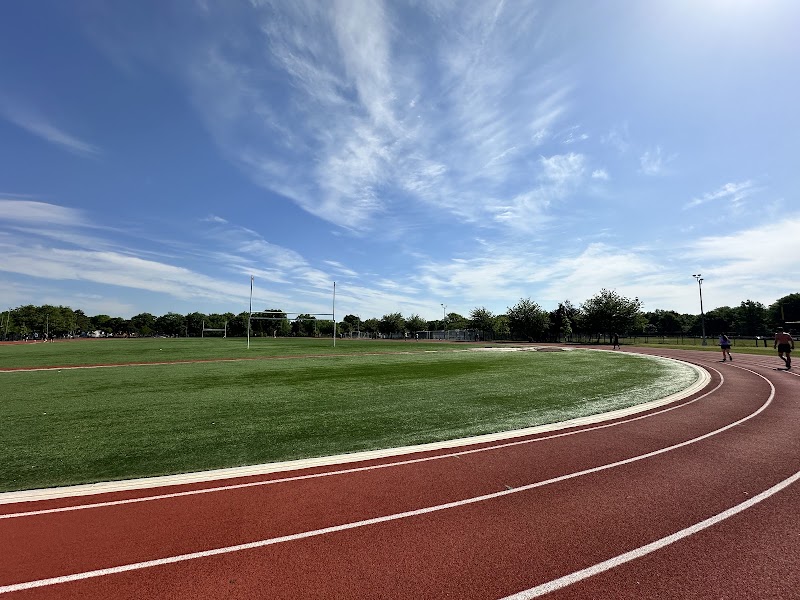
- The quarter-mile running track — a full oval encircling a turf football and soccer field, free and open, and the reason a steady stream of runners passes through the park from dawn onward.
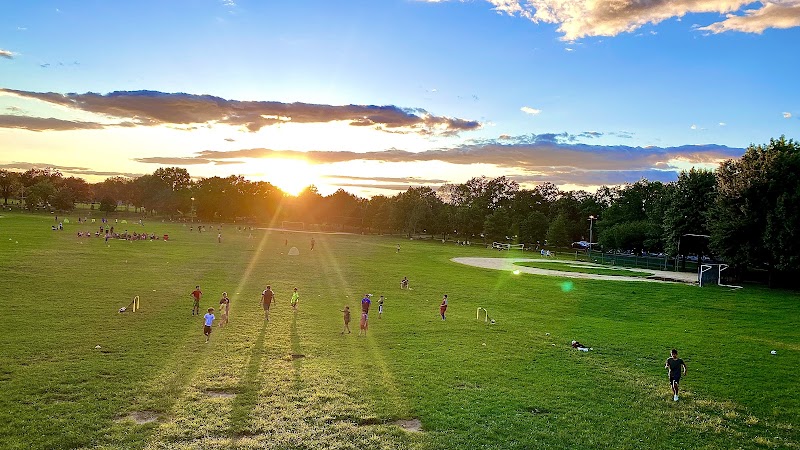
- Seven ballfields — enough diamonds to make this one of the busiest amateur baseball and softball parks in western Queens, with league play filling the weekends from spring into autumn.
- The court complex — tennis, handball, paddleball, basketball and bocce all in one park, plus a roller hockey rink that opened in 1999.
- The WPA bones — the layout you walk on was built by Depression-era relief labour, which planted more than 160 shade trees and thousands of shrubs and left a plan of diamonds, courts and paths that has proved remarkably durable.
- The mature tree canopy — nearly a century on from that planting, the perimeter walks are properly shaded, which in a treeless stretch of Queens rowhouses is a genuine amenity.
What you’ll find
The park is split into two halves by a street running through the middle, and each half has its own personality: one leans athletic, with the track, the turf field and the diamonds; the other leans social, with playgrounds, benches, courts and the shaded perimeter path where the neighbourhood does its laps.
- A quarter-mile track around a synthetic-turf field used for football and soccer.
- Seven baseball and softball diamonds, heavily programmed by local leagues.
- Tennis, handball, paddleball, basketball and bocce courts, plus the roller hockey rink.
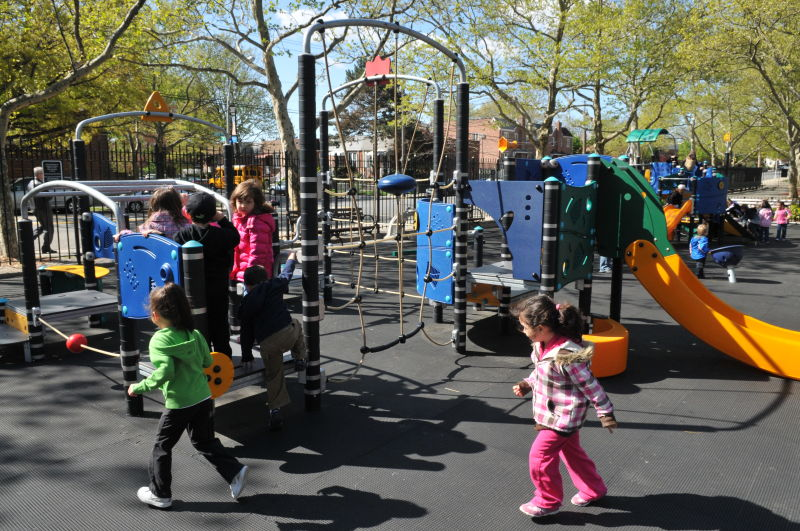
- Multiple playgrounds and spray features for small children, plus a dog run.
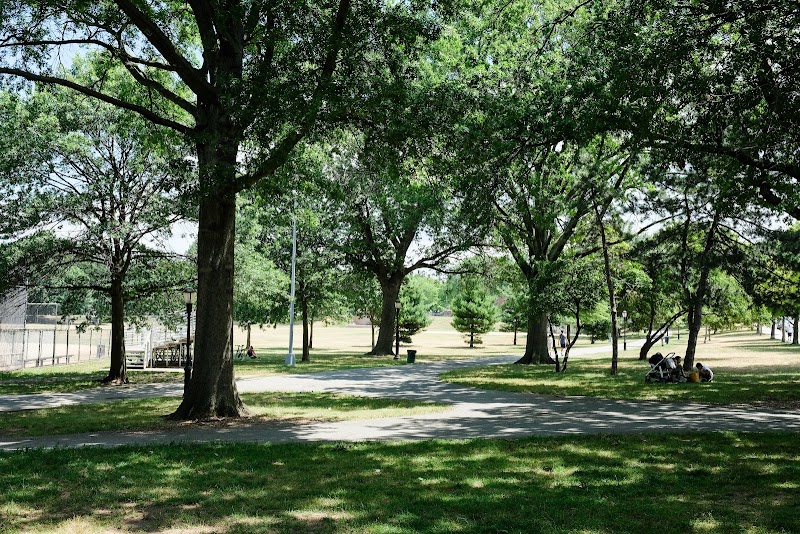
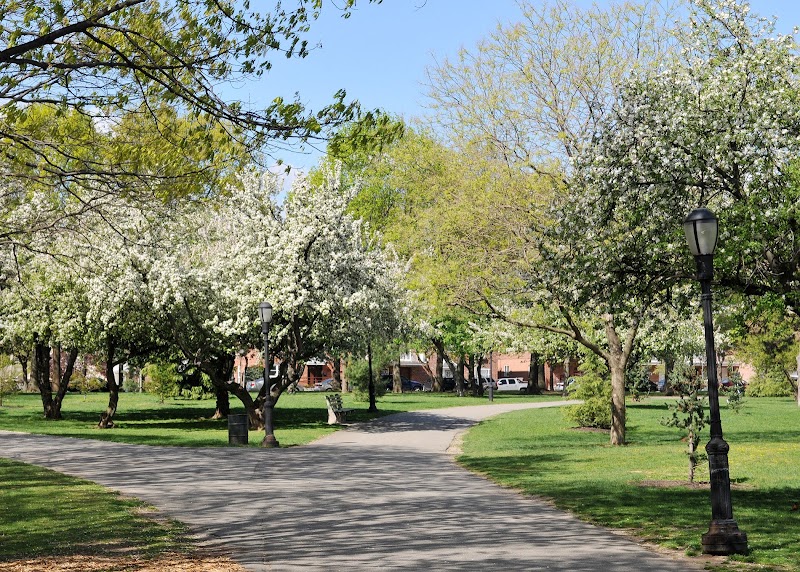
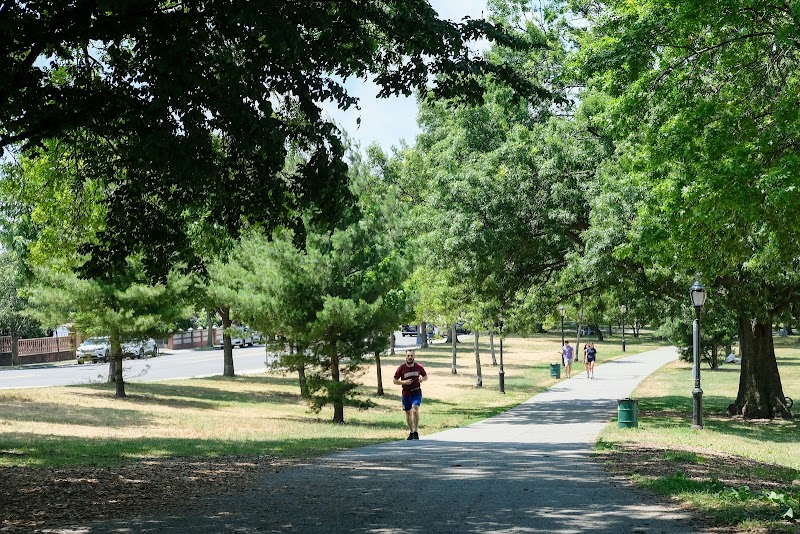
- A perimeter walking loop under mature shade trees, with benches at intervals.
- The fenced Pullis Farm Cemetery with its memorial marker, maintained by neighbourhood volunteers rather than by a cemetery corporation.
Things to do — and who it’s for
- Runners — a measured quarter-mile oval plus a shaded perimeter loop gives you both interval work and easy mileage without a single road crossing.
- Ball players and leagues — seven diamonds and a turf field make this the default home ground for a large slice of western Queens youth and adult sport.
- Families with young children — several playgrounds, water play in summer, flat paths for scooters and strollers, and sightlines that make supervision easy.
- Older neighbours and daily walkers — benches, shade and a level loop have made the perimeter path a genuine social institution in Middle Village.
- History-minded visitors — the cemetery, and the knowledge of what the ground used to be, turn an ordinary walk into something considerably more interesting.
- Dog owners — the dog run and the wide perimeter make this one of the more workable dog parks in the area.
Getting there & practical
Juniper Valley Park sits in the middle of Middle Village, ringed by rowhouses and within reach of the neighbourhood’s famous belt of cemeteries. The simplest rail approach is the M train to its terminal at Middle Village–Metropolitan Avenue, from which the park is a short walk; the Q29, Q38 and Q47 buses all serve the immediate area, and the Q47 links toward LaGuardia. Driving here means street parking around the park’s edges, which is generally findable on weekdays and much tighter on weekend mornings when league games start. Entry is free, there are no gates, and the park follows standard city park hours, opening early and closing late; the athletic facilities are lit for evening use. Restrooms are in a comfort station, generally open in the warmer months. This is a neighbourhood park rather than a destination, so budget forty minutes to an hour unless you are here to play or to run — and if the cemetery is what brought you, it sits along the northern edge and is visible through its fence at any time.
When to visit
Spring is when the park wakes up: leagues return to the diamonds, the trees leaf out over the perimeter path, and weekday mornings are quiet enough for a proper track session. Summer is the loudest season — evening games under the lights, playground sprays running, and a shaded loop that is noticeably cooler than the surrounding streets on a hot afternoon. Autumn is the best-looking time here, with the WPA-planted canopy turning and football taking over the turf field. Winter empties the place out and reveals its geometry — bare trees, empty diamonds, the low fenced rectangle of the cemetery standing out sharply — and it is the one season when you can walk the whole park in fifteen unhurried minutes without meeting anyone.
Good to know
Before the park, this was the Juniper Swamp: roughly a hundred acres of low, wet ground formed by glacial meltwater, named for the eastern red cedar (Juniperus virginiana) that colonised it after British troops cut the original timber around the time of the Revolutionary War. Local histories record the swamp being used for cover by American soldiers during the fighting on Long Island in 1776. It stayed semi-wild for a remarkably long time: in 1918 the botanist Roland M. Harper catalogued its flora and found leatherleaf, arrowhead and blueberry thickets growing nowhere else in the five boroughs, while neighbourhood families used it for berry-picking in summer and skating in winter. Thomas Pullis Sr. bought a 32-acre farm here in 1822 and his family established the burial ground by 1846; after New York banned new burials in Manhattan in 1851, farm plots like this became more common, and the Pullis ground is now one of the last of them. Then came the strange chapter. In the mid-1920s the gambler and fixer Arnold Rothstein — best known as the man behind the 1919 Black Sox World Series scandal — bought the 88-acre swamp and marketed it as “Rothstein’s Estates”, throwing up around 48 empty shell houses across some 50 acres to make the development look real. It became a public scandal as the “phantom village”. A racetrack called Metropolitan Heights opened alongside it in August 1927, hosting horse, dog, car and motorcycle racing before closing within a couple of years. Rothstein was shot in 1928 and died; the city ultimately took the land from his estate against back taxes. Robert Moses then discovered that the swamp sat on a fortune in peat, which was mined out and carted to the grounds of the 1939–40 World’s Fair in Flushing Meadows. Construction began in 1938 with Works Progress Administration labour; on 11 November 1940 the Parks Department announced the completion of four baseball diamonds, a twenty-foot-wide bicycle track, a comfort station and a battery of tennis, paddle tennis, badminton, handball and shuffleboard courts. The full fifty-five acres were built out by 1967. The Juniper Park Civic Association, which publishes the neighbourhood journal The Juniper Berry, has watched over the park for decades; a volunteer effort founded on 16 January 1993 by Ed Shusterich took on the cemetery’s restoration, an application for city landmark designation was declined by the Landmarks Preservation Commission in 2020, and a community restoration project refreshed the site again in 2025.
Visitor tips
- Come on a weekday morning if you want the track. Weekend mornings from spring through autumn belong to the leagues, and the diamonds and turf field are fully booked.
- Walk the perimeter loop rather than cutting across. It is the shadiest route, it passes the cemetery, and it is the only way to get a sense of the park’s original WPA layout.
- Pair the visit with the neighbourhood’s cemetery belt. Middle Village is surrounded by some of the city’s largest burial grounds, and seeing the tiny Pullis plot in that context makes the contrast between a family farm graveyard and an industrial-scale cemetery immediately clear.
Questions & answers
Is there still a pond or swamp in the park? No. The ponds where neighbours once skated were drained and the swamp filled during construction from 1938 onward, after the peat beneath it was mined out. The park’s ground is entirely engineered — the name is now the only trace.
Can I visit the Pullis Farm Cemetery? You can see it clearly: the plot is fenced, marked and maintained by volunteers along the park’s northern side. It is a burial ground rather than an attraction, so it is viewed from outside the fence.
Is the running track open to the public? Yes, free and unbooked outside organised use — a quarter-mile oval around the turf field, which is why local runners treat it as their default speed-work venue.
How do I get here without a car? The M train’s Middle Village–Metropolitan Avenue terminal is the closest rail stop and a short walk away; the Q29, Q38 and Q47 buses serve the surrounding neighbourhood.
Is it good for young children? Very. There are several playgrounds with summer water play, level paths for scooters and strollers, and short distances between everything, which makes it an easy park to manage with toddlers.
Are there restrooms and drinking water? There is a comfort station and drinking fountains, generally operating in the warmer months and reduced or closed in winter, as is standard for city parks.
Can I bring a dog? Yes — there is a dog run, and dogs are welcome on lead elsewhere. The city’s designated off-leash hours apply where they are posted.
Was this really owned by a famous gangster? Yes. Arnold Rothstein bought the swamp in the mid-1920s and built a fake development of empty houses on it; after he was shot in 1928 the city acquired the land from his estate against unpaid taxes, which is how a notorious fraud became a public park.
Photos
Show 1 more photos
Visitor reviews
Reviews last updated: 2026-08-04 20:07:37
Data is refreshed monthly. Sources: queens.name and editorial picks based on reviews.
Чудовий парк, ходжу сюди з дитинства. Ми доглянули парк, доріжки дуже чисті. У них багато тенісних кортів, 1 майданчик для піклболу, бейсбольні поля, поле для софтболу та баскетбольні кільця. Гарний дитячий майданчик, і…
Вражаюче доглянутий районний парк пропонує широкий спектр розважальних зручностей. У парку є дитячі майданчики, тенісні корти, бейсбольні поля, ковзанка для роликового хокею та спеціально відведені пішохідні та велосипед…
«Джуніпер Парк» – справді одне з найкрасивіших і найспокійніших місць у цьому районі. Незалежно від того, чи ви збираєтеся на тиху прогулянку, пробіжку чи просто розслабитися, парк пропонує ідеальне поєднання природи та…
Як людина, яка нещодавно переїхала з Орегону, я завжди шукаю природні місця, які нагадують мені про дім, і парк Джуніпер Веллі саме для цього. Захований у Квінзі, цей парк швидко став одним з моїх улюблених відкриттів. В…
Гарне місце, багато зелені. Багато місця для занять спортом і для відпочинку. Завжди є місце для парковки. Єдине що напрягає це власники собак які вигулюють їх без повідків. Це досить дивно бо їх можна зустріти в любий ч…