

Park · Queens · ⭐ 9.5/10 · 12986 reviews · updated: 2026-08-04 20:07:32
Address: 19 19th St, Astoria, NY 11105, United States
Astoria Park — two great bridges, one enormous pool, and the best sunset in Queens
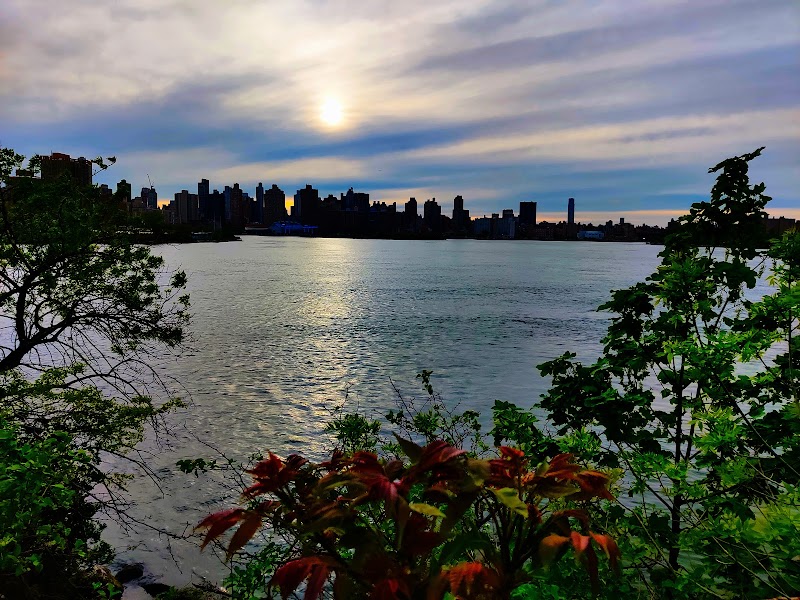
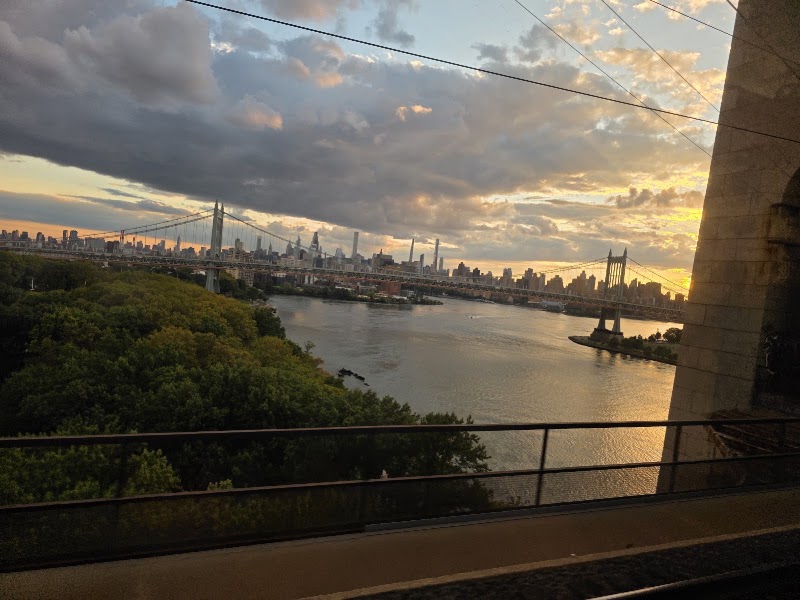
Sixty acres of lawn and plane trees run down to the East River at its most dangerous point, a tidal strait the Dutch called Hellegat and English speakers turned into Hell Gate. Two of New York’s most dramatic bridges frame the park — a red steel railroad arch at the north end, the long span of the Robert F. Kennedy Bridge at the south — and between them sits the largest outdoor swimming pool in the city, opened in 1936 and built to hold thousands. The Manhattan skyline stands directly across the water, which means Astoria Park faces west, which means that on a clear evening half the neighborhood walks down to the shore path to watch the sun go down behind the towers.
Highlights
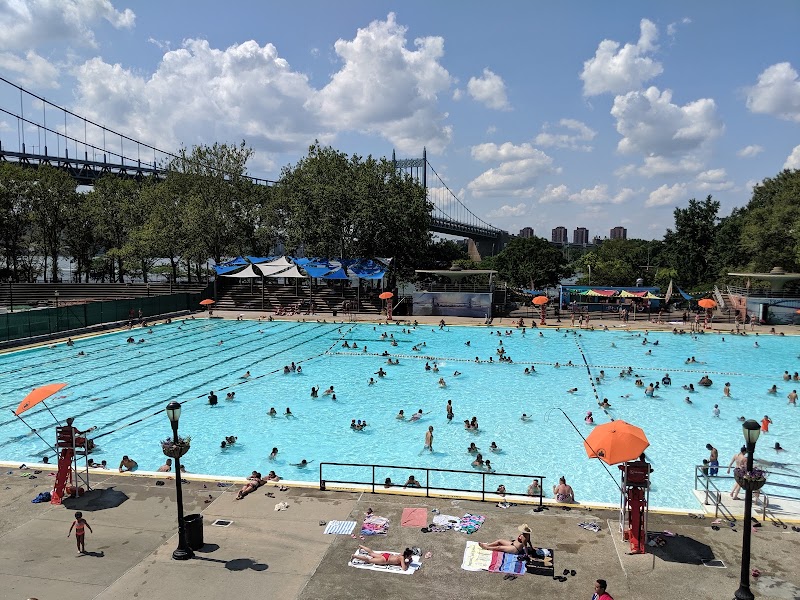
- Astoria Pool — opened on July 2, 1936, one of eleven monumental outdoor pools the Parks Department unveiled that single summer under Robert Moses with Works Progress Administration money. Designed by architect John Matthews Hatton, the main basin measures 330 by 165 feet — some 54,450 square feet of water — and was originally built for a peak of more than six thousand swimmers. The pool and its bathhouse were designated a New York City landmark on June 20, 2006.
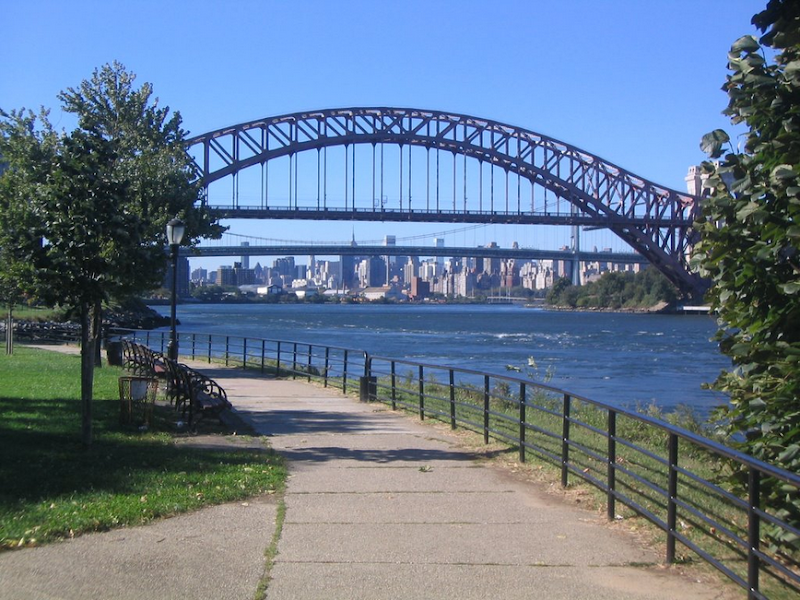
- Hell Gate Bridge — Gustav Lindenthal’s steel arch, dedicated on March 9, 1917, with a main span of 977.5 feet that made it the longest steel arch bridge in the world until the Bayonne Bridge opened in 1931. It directly influenced the design of the Sydney Harbour Bridge, carries Amtrak’s Northeast Corridor and freight trains, and wears a deep shade chosen in the 1990s and known ever since as Hell Gate Red.
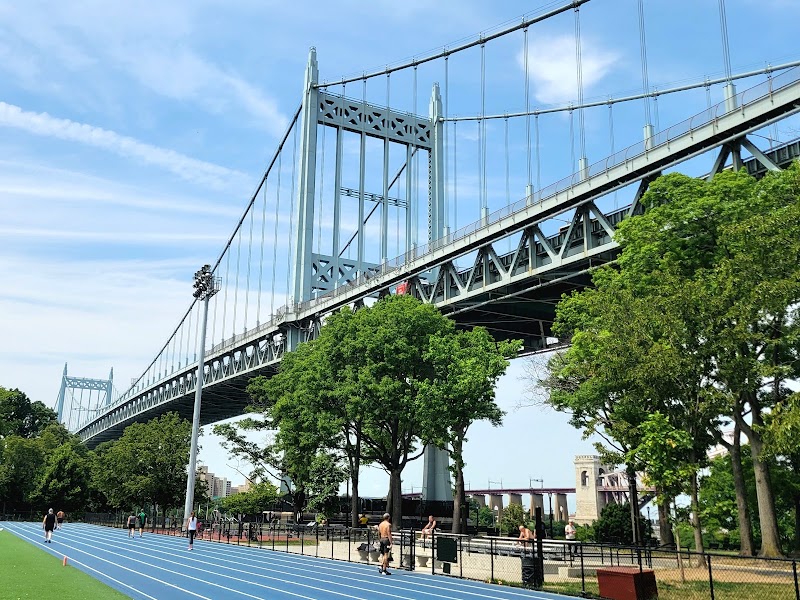
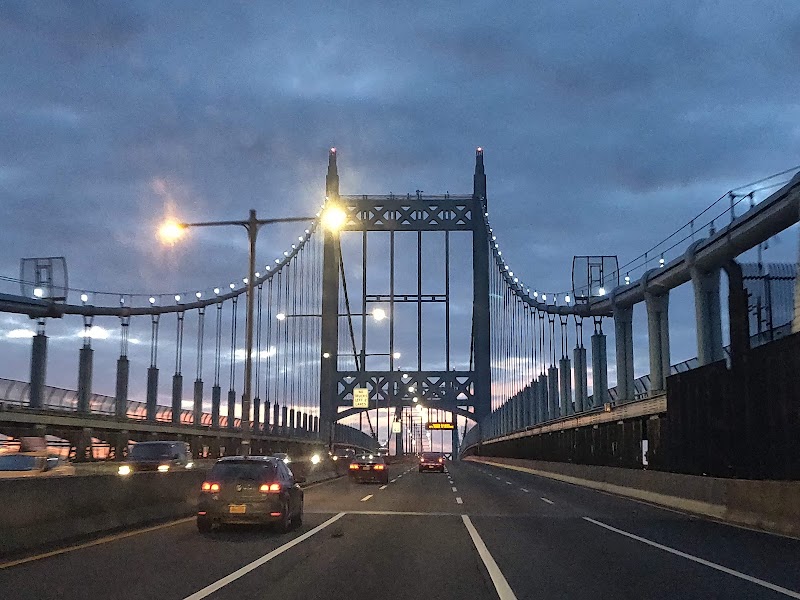
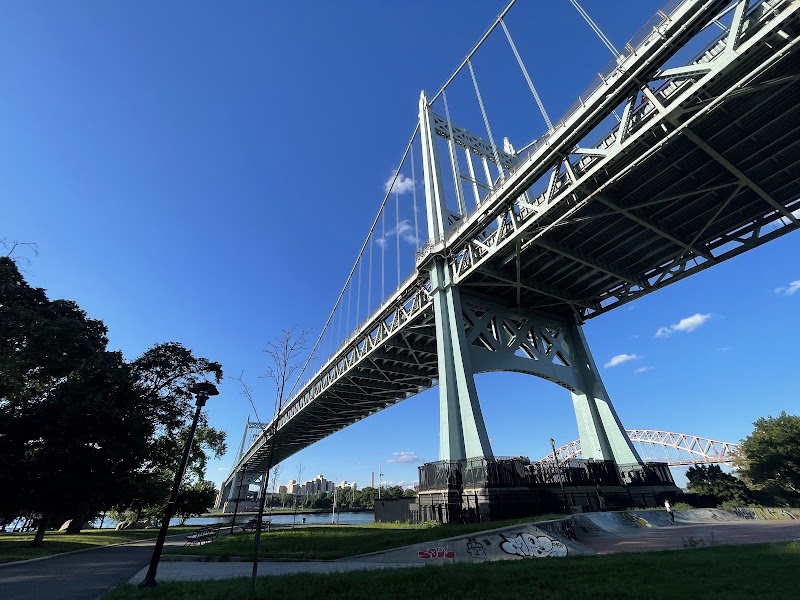
- The Robert F. Kennedy (Triborough) Bridge — opened on July 11, 1936, the same summer as the pool, engineered by Othmar Ammann as the keystone of Robert Moses’s road network. Its approach ramps sweep over the park’s southern lawns, and walking beneath them is one of the strangest and most cinematic experiences in Queens.
- The shore path — a waterfront promenade running the length of the park along the strait, with unbroken views of Manhattan, Randalls and Wards Islands and the churning tidal water of Hell Gate itself.
- The running track — a quarter-mile, eight-lane rubberized oval, recently rebuilt, that draws school teams, club runners and a free weekly community run all year round.
- Charybdis Playground — built alongside the pool in 1936 and given its present name in 1997 after the mythological whirlpool, a pointed reference to the water just below it. It has since been comprehensively rebuilt for a new generation.
What you’ll find
Astoria Park is a working neighborhood park with a monumental spine. The land rises from the river in broad terraces, so almost every lawn has a view; the athletic facilities cluster inland, the pool and playground sit at the water’s edge under the Hell Gate arch, and the whole thing is stitched together by paths that were laid out when the park was formally named in December 1913.
- Fourteen tennis courts, a soccer field, basketball courts and bocce courts, in near-constant use from spring through autumn.
- A skate park of roughly 21,500 square feet, one of the largest in the borough.
- A bandstand and open lawns used for free summer concerts and outdoor films.
- Broad picnic lawns on the upper terraces, and long benches facing the water on the lower ones.
- Wide, shaded walkways that make the park a genuine through-route for the surrounding streets rather than a destination you have to plan for.
- Views that change completely depending on where you stand: skyline to the west, the red arch to the north, the great bridge to the south.
Things to do — and who it’s for
- Swimmers — in season, a genuinely historic public pool at a scale nothing modern matches, with free admission and two daily sessions split by a cleaning break.
- Runners and cyclists — a rebuilt eight-lane track for intervals, a riverside path for distance, and a free weekly community run that welcomes walkers.
- Photographers and skyline hunters — the park faces Manhattan across open water with two landmark bridges in frame, and the evening light here is the reason people cross the borough.
- Families — a large modern playground, spray features in summer, wading water, and lawns big enough that nobody is on top of anybody else.
- Skaters and teenagers — one of the biggest skate parks in Queens, right beside the athletic fields.
- People who like structures — walking directly under the Hell Gate approach viaducts and the RFK ramps is an education in early-twentieth-century engineering that no photograph conveys.
Getting there & practical
The park sits in Astoria, in northwestern Queens, and it is straightforward to reach by subway. The N and W trains stop at Astoria Boulevard and at Ditmars Boulevard, both a short walk from the park’s edges; the M60 SBS bus, which links Manhattan with LaGuardia Airport, passes close by, as do the Q19, Q69 and Q100. Entry to the park is free at all times. The pool is free as well but operates only during the summer swimming season, in two daily sessions separated by a cleaning break, with a strict list of what you may bring onto the deck — a padlock for the lockers is essential, and glass is not permitted. Tennis courts require the city’s seasonal permit or a single-play ticket. The grounds are open daily from early morning until 1 a.m., though the shore path is best treated as a daylight walk. Ninety minutes is enough for a loop of the park with a stop at the water; make it a half day if you are swimming.
When to visit
Spring is when the terraces green up and the track and courts fill again after winter; the air off the strait is still cold, but the light is clean and the crowds have not arrived. Summer is the park’s season outright — the pool opens, the free concert and film programme runs on the lawns, and the annual Independence Day fireworks over the East River, one of the longest-running celebrations in Queens, pulls in thousands who stake out the slopes hours ahead. Autumn is the connoisseur’s choice: warm days, cold clear evenings, foliage on the upper lawns, and the sharpest skyline visibility of the year as the summer haze lifts. Winter empties the place out and hands it to runners, dog walkers and photographers — the bare trees open sightlines that summer hides, and Hell Gate under low grey light with the red arch above it is one of the great melancholy views of New York.
Good to know
The city acquired this land in October 1913 and formally named the park that December, after the surrounding village of Astoria — itself named in the 1830s in honor of John Jacob Astor, in the hope that the merchant would invest in the place. He never did in any serious way, but the name stuck. The water below is the reason the park exists as open space at all: Hell Gate, from the Dutch Hellegat, was a notorious tidal strait where reefs and submerged rock pots threw up whirlpools and eddies that wrecked ships regularly through the nineteenth century. The U.S. Army Corps of Engineers answered with explosives, blasting Hallett’s Point Reef in 1876 and detonating Flood Rock in October 1885 in what was, at the time, one of the largest planned explosions ever set off. The park’s monumental phase came with the New Deal. Astoria Pool was one of eleven immense outdoor pools opened across the city in the summer of 1936, financed by the Works Progress Administration and driven by Robert Moses as public health infrastructure for working-class neighborhoods; the design by John Matthews Hatton was deliberately heroic, with brick and concrete on a civic scale. Its opening was immediately followed by national attention: Astoria Pool hosted the United States Olympic swimming trials in 1936, and again in 1952 and 1964. The original complex included a separate diving pool with high platforms, used in those trials; long closed to the public, it was filled in between 2017 and 2019. The main pool itself underwent a roughly nineteen-million-dollar reconstruction of its shell, gutter, deck and filtration systems and reopened to swimmers in late June 2024 after about two years shut. The bridges bracket that history at either end — Lindenthal’s 1917 arch, which was the longest of its kind in the world and became the model for Sydney; and Ammann’s Triborough, opened in July 1936, which knitted Queens, Manhattan and the Bronx into a single road system and made Moses’s career.
Visitor tips
- Come for the last hour before sunset. The park faces west across open water and the light on the skyline and on the Hell Gate arch is the single best thing here — bring something warm, because the wind off the strait is always colder than the street.
- If you plan to swim, check the season dates and session times first, and bring a padlock. City pools run in two daily blocks with a cleaning break between, and the rules on what can come poolside are enforced.
- Walk the full length of the shore path rather than stopping at the pool. The stretch beneath the Hell Gate viaduct arches is the part visitors miss and the part locals bring guests to see.
Questions & answers
Is Astoria Park free? Yes. The park, the shore path, the lawns, the track and the playgrounds are free and open daily from early morning until 1 a.m. Astoria Pool is also free to enter during the summer season. Tennis courts require the city’s seasonal permit or a single-play ticket.
Is Astoria Pool really the biggest in New York City? Yes — it is the largest outdoor public pool in the city’s park system. The main basin is 330 by 165 feet, about 54,450 square feet of water, and when it opened in 1936 it was built to handle a peak of more than six thousand swimmers at once.
When is the pool open? Only during the summer swimming season, and only in two daily sessions with a cleaning break between them. It is closed the rest of the year. Check the current season dates before you travel, as they shift slightly from year to year.
Which bridges can you see from the park? Two, and both are close enough to dominate. The Hell Gate Bridge, a steel railroad arch dedicated in 1917, crosses at the northern end; the Robert F. Kennedy (Triborough) Bridge, opened in July 1936, crosses at the southern end. The Manhattan skyline fills the view straight across the water.
Why is it called Hell Gate? The name comes from the Dutch Hellegat. The strait was genuinely dangerous — reefs and rock formations on the bottom created whirlpools and violent eddies that sank ships for centuries, until the Army Corps of Engineers blasted the worst of the rock away in 1876 and 1885.
Did the Olympics ever happen here? Not the Games themselves, but the United States Olympic swimming trials were held at Astoria Pool in 1936 — the year it opened — and again in 1952 and 1964. The high diving platforms used then belonged to a separate diving pool that was closed long ago and filled in between 2017 and 2019.
How do I get there by subway? Take the N or W train to Astoria Boulevard or to Ditmars Boulevard; either station leaves a short walk to the park. The M60 SBS, Q19, Q69 and Q100 buses also serve the area.
Is it good for children? Yes. Charybdis Playground is large and recently rebuilt, there are water play features in summer, the lawns are broad and open, and the pool has shallow areas. The park is popular with families all season.
How long should I allow? About ninety minutes for a proper loop — track, lawns, both bridge ends and the shore path. Half a day if you are swimming, and add an hour if you want to stay for sunset, which is the reason most people come.
Photos
Show 1 more photos
Visitor reviews
Reviews last updated: 2026-08-04 20:07:32
Data is refreshed monthly. Sources: queens.name and editorial picks based on reviews.
The Astoria Park pool has definitely made a huge comeback over the years. I remember when it had a reputation as a dirty place where you wouldn't necessarily want to spend the day, even though it was free. However, after…
I travel with the fair/carnival, and this is my favorite spot of the year!! There are food vendors, a tennis court, a skateboard park, a track, a nice park to relax in!! The views are beautiful… the people are eccentri…
I came here with my boyfriend, who was pretty suspicious about it, pretty sure he's brought other people here, since it's a pretty decent place. I almost had a panic attack trying to find a parking spot, honestly, but wh…
Astoria Park is definitely one of the best parks in Queens. The view of Manhattan alone is worth the visit, especially at sunset. But what really makes this place special is the atmosphere: it feels safe, welcoming and v…
Well, I caught a shiny Pokémon there, recommend!