

Park · Queens · ⭐ 9.3/10 · 30255 reviews · updated: 2026-08-04 20:07:32
Address: P5R5+2P, Flushing, NY 11354, United States
Flushing Meadows Corona Park — the fairground that became Queens’ great park
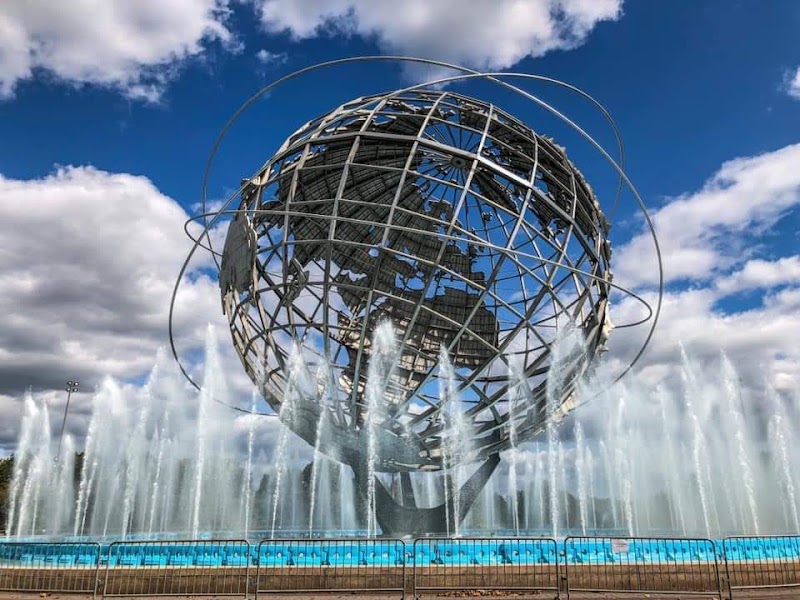
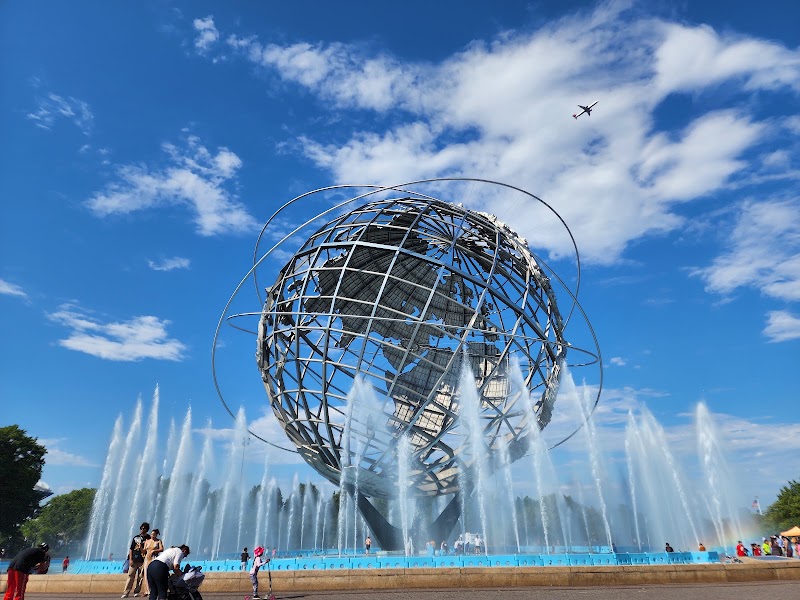
A stainless-steel globe twelve stories high stands at the center of 897 acres, ringed by fountains and circled by three steel orbits, and almost everything around it was once a promise about the future. This is the ground F. Scott Fitzgerald turned into the “valley of ashes” in The Great Gatsby; the ground Robert Moses buried under lawns and lakes; the ground that staged two World’s Fairs a generation apart; and the ground where the United Nations General Assembly met before it had a home of its own. Today it is the largest park in Queens and the fourth-largest in New York City — a museum with a scale model of the entire city inside it, a science center, a zoo under a geodesic dome, two lakes, cricket pitches, a major league ballpark, the home of the US Open, and the vast concrete bones of a pavilion that has outlived everything it was built to celebrate.
Highlights
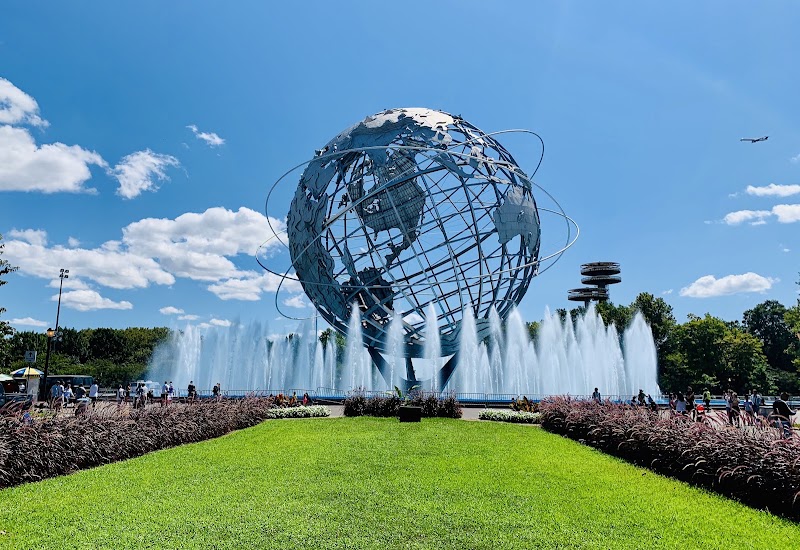
- The Unisphere — the theme symbol of the 1964–65 World’s Fair: 140 feet tall, 120 feet in diameter and about 700,000 pounds of stainless steel, fabricated by the American Bridge Company and donated by U.S. Steel. It is tilted 23.5 degrees to match the Earth’s axis, and three steel rings trace the orbits of Yuri Gagarin, John Glenn and the Telstar satellite. Designated a New York City landmark in 1995, it sits in a reflecting pool roughly 310 feet across, ringed with paired fountain jets.
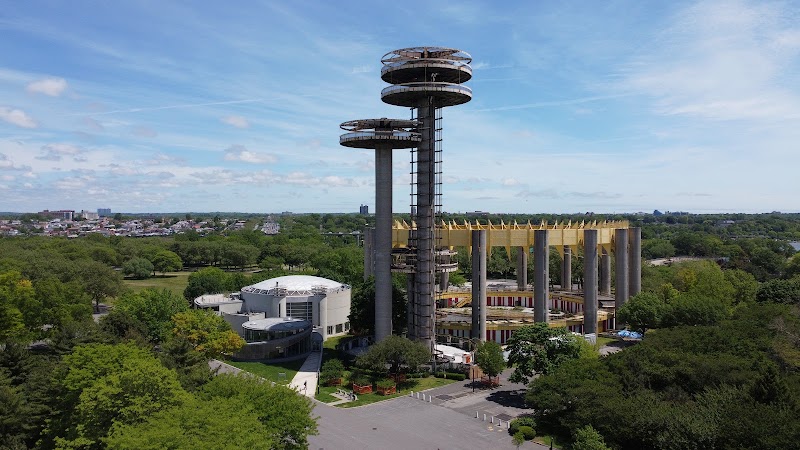
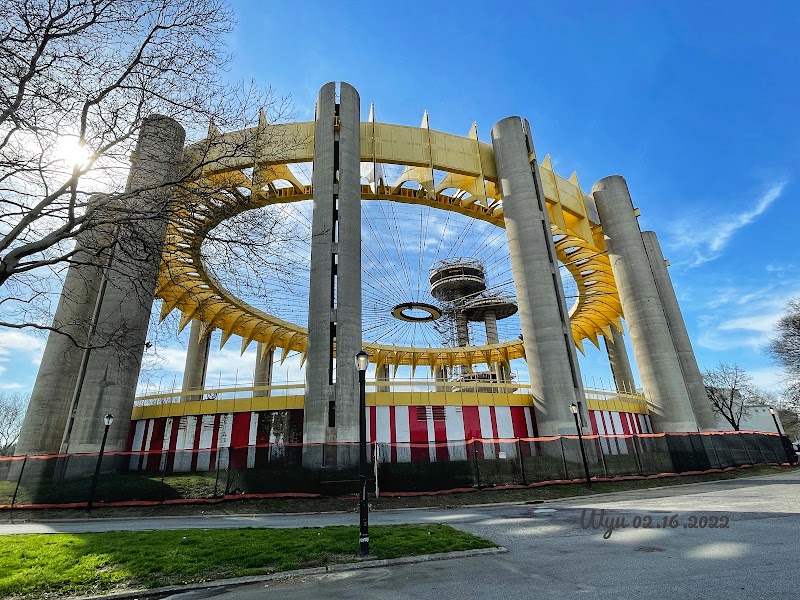
- The New York State Pavilion — Philip Johnson and Richard Foster’s 1964 pavilion, engineered by Lev Zetlin: an elliptical ring of concrete columns 250 by 350 feet, once roofed in translucent colored plastic and floored with a Texaco road map of New York State laid in 567 terrazzo panels. Its three observation towers rise 226, 150 and 60 feet. Listed on the National Register of Historic Places in 2009, it is being stabilized in phases and is not open for general entry — you view it from the surrounding paths.
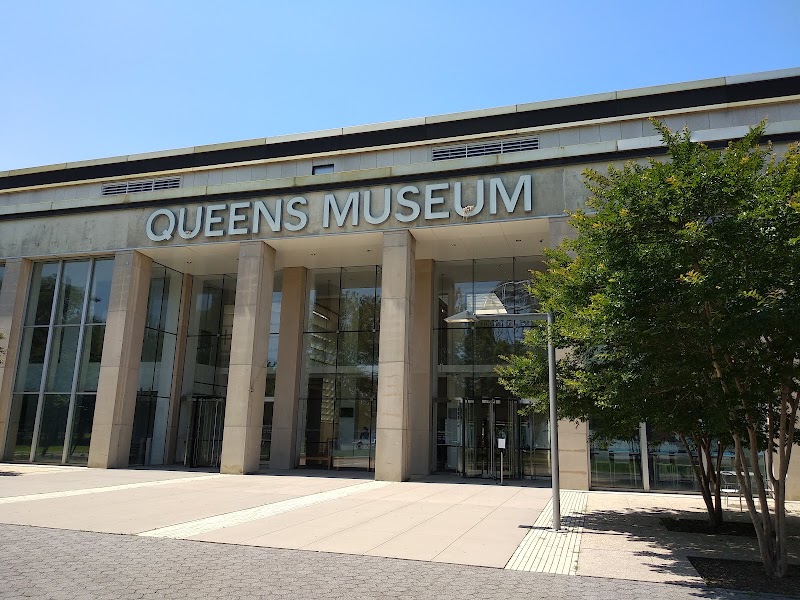
- The Panorama of the City of New York — inside the Queens Museum, a 9,335-square-foot architectural model of all five boroughs at a scale of one inch to one hundred feet, built by Raymond Lester & Associates on commission from Robert Moses for the 1964 fair. After a comprehensive update in 1992 it holds roughly 895,000 buildings, and visitors circle it on elevated ramps designed by Rafael Viñoly.
- New York Hall of Science — one of the few structures still standing from the 1964 fair. Wallace Harrison’s Great Hall is an undulating concrete wall eighty feet high, pierced with cobalt-blue dalle de verre glass so the interior glows underwater blue. Outside, Rocket Park displays restored Atlas and Titan II rockets left over from the fair.
- Queens Zoo and its geodesic aviary — eleven acres run by the Wildlife Conservation Society, focused entirely on the animals of the Americas: Andean bears, pumas, California sea lions, bison, coyotes and thick-billed parrots. The aviary occupies a geodesic dome about 175 feet wide that was built for the 1964 fair, and a separate farm section keeps domestic animals.
- Meadow Lake and Willow Lake — the park’s whole southern half is water and open ground. Meadow Lake is the largest lake in the city and carries dragon boats, kayaks and pedal boats in season; Willow Lake behind it is a quiet nature preserve on a marked trail, and a tide-gate bridge between them lets water move north only.
What you’ll find
The park reads as three overlapping worlds. North of the Grand Central Parkway are the institutions and the sports venues; the middle holds the fairground core — the Unisphere, the Pavilion, the fountains and the great axial promenades laid out by landscape architects Gilmore D. Clarke and Michael Rapuano for 1939 and reused in 1964; the south is lakes, cricket, barbecues and marshland. It is a park you cross rather than stroll, and the scale is deliberate: these were avenues built to move tens of millions of fairgoers.
- Cultural anchors: the Queens Museum in the 1939 New York City Building, the New York Hall of Science, the Queens Zoo and Queens Theatre, which has performed inside the Pavilion’s old Theaterama since 1989.
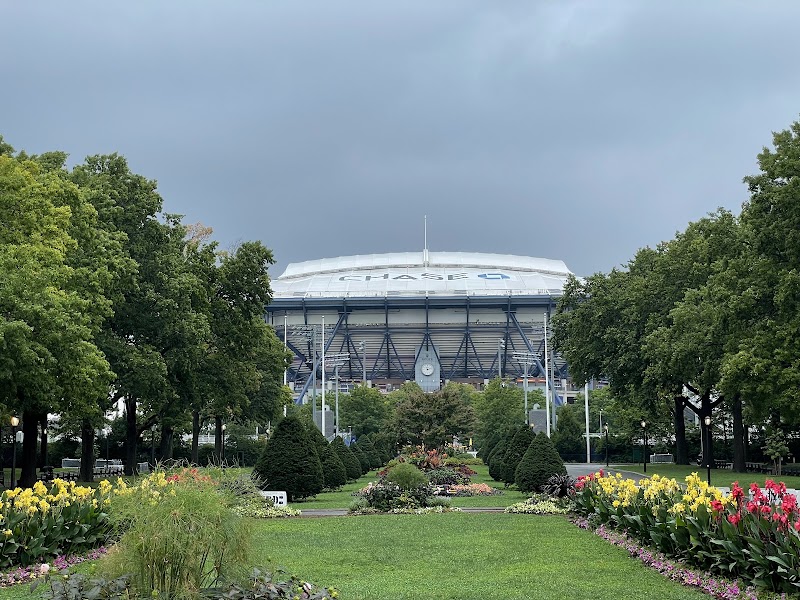
- Big-league sport: Citi Field, home of the New York Mets since 2009 on the site of the demolished Shea Stadium, and the USTA Billie Jean King National Tennis Center, where the US Open has been played since it moved from Forest Hills in 1978.
- Fairground survivors: the Column of Jerash, a Roman column roughly thirty feet tall given by King Hussein of Jordan in 1964 and the second-oldest man-made object in New York City after Cleopatra’s Needle; Donald De Lue’s bronze Rocket Thrower; Marshall Fredericks’ Freedom of the Human Spirit; the Fountain of the Planets on the site of the 1939 Lagoon of Nations; and Terrace on the Park, the fair’s heliport building, still standing on its concrete legs.
- Everyday recreation: dozens of cricket pitches and soccer fields, barbecue and picnic grounds around Meadow Lake, a marked model aircraft field, a carousel, playgrounds, and miles of flat paved paths for running and cycling.
- The Aquatics Center, opened in 2008 — an indoor Olympic-size pool and an NHL-regulation ice rink under one roof, about 110,000 square feet and the largest recreation building in any New York City park.
- Buried history: the Westinghouse time capsules, an 800-pound alloy tube sunk fifty feet down during the first fair and a companion added during the second, both addressed to the year 6939.
Things to do — and who it’s for
- History and architecture travelers — walk the fairground axis from the Unisphere to the Pavilion and read a century of ambition in one sightline: ash dump, 1939 optimism, wartime, the United Nations, 1964 spectacle, decay, and slow rescue.
- Families with children — the Hall of Science, the zoo and the science playground sit within a few minutes of each other, so a single visit covers hands-on exhibits, animals and running-around space without a car.
- Sports fans — a Mets game and the US Open share one subway stop, and the park’s own fields carry the borough’s cricket and football leagues all weekend long.
- Runners and cyclists — the loop around Meadow Lake and the long straight promenades give miles of flat, uninterrupted, traffic-free surface, unusual in New York.
- Birders and quiet walkers — Willow Lake Preserve and the marshy southern edges hold herons, egrets and migrating waterfowl a short walk from the crowds.
- Photographers — the Unisphere at first light, the Pavilion’s towers at dusk and the Panorama’s model skyline are three of the most photographed subjects in Queens, and all three reward patience with the light.
Getting there & practical
The park lies between Corona, Flushing, Forest Hills and Rego Park, and it is one of the easiest large parks in the city to reach without a car. The 7 train — local and express — stops at Mets–Willets Point, where an elevated walkway, the Passerelle, carries you straight over the tracks and down into the fairground core; the Long Island Rail Road’s Port Washington Branch also serves that station for games and major events. Local buses including the Q48, Q58, Q64 and Q88 run along the park’s edges, and the 7 train’s Flushing–Main Street terminal puts you a short walk from the northern end. Entry to the park itself is free and always has been; the Queens Museum, the New York Hall of Science, the Queens Zoo, the Aquatics Center, golf and tennis court time are separately ticketed, and the Mets and the US Open are separate again. The grounds are open daily from early morning until 1 a.m., though the institutions keep their own shorter hours and most close at least one day a week. Give a first visit three to four hours for the fairground core alone; a full day if you plan to add a museum and the lakes.
When to visit
Spring brings the cricket season back to the southern fields, flowering trees along the promenades, and the reopening of the outdoor food market that fills the ground near the Hall of Science on weekend evenings — the park’s most crowded and most joyful hours. Summer is the park at full volume: barbecue smoke over Meadow Lake, dragon boat crews training and racing on the water, Mets home stands, free concerts, and long light that keeps the Unisphere’s fountains running into the evening. Late August into September belongs to the US Open, when the whole northern end fills and the 7 train runs packed; if you want the park quiet, come early in the morning that fortnight. Autumn is arguably the best walking season — clear air, gold and russet around the lakes, thinner crowds, and hawks and waterfowl moving through. Winter strips the park back to its structure, which is when the Pavilion looks most like a ruin and most like sculpture; the indoor rink and pool at the Aquatics Center carry the cold months, and the lakes draw wintering ducks and geese.
Good to know
For most of its history this was not parkland at all. From around 1910 the Brooklyn Ash Removal Company dumped the city’s coal ash and refuse here — an estimated 50 million cubic yards of it — building grey hills over the tidal marsh of the Flushing River. Fitzgerald put the place into The Great Gatsby in 1925 as the “valley of ashes,” and it is the single most famous description of any landscape in Queens. Robert Moses, appointed Parks Commissioner in 1934, saw a park in it and used a World’s Fair to pay for the clean-up. The 1939–40 fair opened on April 30, 1939 with the theme “Building the World of Tomorrow”; its centerpiece was the Trylon, a spire 610 feet tall, and the Perisphere, a sphere 180 feet across, both by Wallace Harrison and J. André Fouilhoux, containing Henry Dreyfuss’s model city Democracity. After the war the fair’s New York City Building housed the United Nations General Assembly from 1946 until 1950 — the partition vote on Palestine of November 1947 was taken in that room — while the Security Council met nearby at Lake Success. Moses came back for a second fair in 1964–65, again under the landscape hand of Clarke and Rapuano, this time with the theme “Peace Through Understanding” and the Unisphere as its symbol; more than 51 million people passed through. The New York State Pavilion is the great survivor of that fair. Its colored roof panels were taken down in the late 1970s, its Sky Streak capsule elevators were removed in 2008, and it stood derelict long enough to be cast as a flying saucer in Men in Black in 1997. Preservationists organized as People for the Pavilion in the early 2010s; the tent was repainted in 2015 in a job that took over eight thousand hours and some 1,600 gallons of paint, a first stabilization phase repairing concrete, tower cables and interior stairs was completed in 2023, and a much larger restoration — funded at roughly fifty million dollars and including architectural lighting for the towers and the tent — has been running since, with the intention of eventually allowing limited guided tours. The park has its own long-term worry: it is low and flat, it sits on filled marsh, and studies funded in part by a 2022 NOAA grant treat regular flooding here as a question of when, not whether. The Flushing Meadows–Corona Park Conservancy, founded in 2002, and the Alliance for Flushing Meadows–Corona Park, founded in 2015, raise money and volunteers against exactly that future.
Visitor tips
- Enter from the Mets–Willets Point station rather than the southern end if it is your first visit — the Passerelle delivers you onto the fair axis with the Unisphere straight ahead, which is how the park was designed to be seen.
- Check the Mets schedule and the US Open dates before you come. On a home stand or a tournament day the northern end and the trains are packed, while the lakes at the southern end stay calm.
- Treat the Pavilion as an exterior monument. Circle it, photograph it from the fountain side at low sun, and do not expect to get inside — the restoration is ongoing and access is limited to occasional organized openings.
Questions & answers
Is Flushing Meadows Corona Park free to enter? Yes. The park and all its paths, lawns, promenades and the Unisphere plaza are free and open daily from early morning until 1 a.m. The Queens Museum, the New York Hall of Science, the Queens Zoo and the Aquatics Center charge separately, as do golf, tennis courts, Mets games and the US Open.
Can you go inside the New York State Pavilion? Not as a walk-up visitor. The structure has been under a phased stabilization and restoration program — concrete, tower cables and stairs first, then wider works including architectural lighting — and the stated goal is limited guided tours once the work allows. Until then it is a spectacular thing to look at from the outside, and worth doing.
What exactly is the Unisphere? It is the theme symbol of the 1964–65 World’s Fair: a stainless-steel model of the Earth 140 feet tall and 120 feet in diameter, weighing about 700,000 pounds, built by the American Bridge Company and donated by U.S. Steel. Its three rings represent the orbital flights of Gagarin and Glenn and the Telstar communications satellite. It became a New York City landmark in 1995.
Why is this park connected to The Great Gatsby? Because before it was a park it was the Corona ash dumps, where the city tipped roughly 50 million cubic yards of coal ash from around 1910. F. Scott Fitzgerald described that landscape in his 1925 novel as the “valley of ashes,” the desolate stretch his characters drive through between Long Island and Manhattan.
Did the United Nations really meet here? Yes. The General Assembly sat in the New York City Building — the 1939 fair pavilion that is now the Queens Museum — from 1946 until 1950, while the permanent headquarters was being built in Manhattan. The 1947 vote on the partition of Palestine was taken in that hall.
How much time do I need? Three to four hours covers the fairground core on foot: Unisphere, Pavilion, fountains and the promenades. Add roughly two hours for the Queens Museum and the Panorama, two for the Hall of Science, or ninety minutes for the zoo. Walking down to Meadow Lake and back adds another hour and is worth it.
Is the park good for children? Very. The Hall of Science with its outdoor science playground, the Queens Zoo with its farm section, a carousel, several playgrounds and enormous safe lawns sit close together, and everything is flat and stroller-friendly.
What is the Panorama of the City of New York? A hand-built architectural model of all five boroughs at 1:1200 — one inch to one hundred feet — covering 9,335 square feet at the Queens Museum. Built for the 1964 fair over three years, updated comprehensively in 1992, it now shows some 895,000 buildings, and an adopt-a-building program funds ongoing additions.
Can you get on the water? Yes, seasonally. Meadow Lake is the city’s largest lake and supports kayaks, pedal boats and a strong dragon boat racing scene in summer. Willow Lake, further south, is a preserve for walking and wildlife watching rather than boating.
Photos
Show 1 more photos
Visitor reviews
Reviews last updated: 2026-08-04 20:07:32
Data is refreshed monthly. Sources: queens.name and editorial picks based on reviews.
As a diehard city dweller, I never knew how to spell the word "park" until I did graduate work in park conservation; I really had no relationship with nature, and it had none with me. Visiting my siblings in New York, th…
Nice park! We were there for Governors Ball, it was so much fun! The security and the staff on site were very friendly, helpful, and made sure everyone was drinking water — they handed it out to everybody.
This is one of the largest and most impressive parks in New York. It's a perfect place for walking, relaxing and enjoying a peaceful atmosphere in the very heart of the city.
It boasts huge green spaces, lakes, sports ar…
I'm sure it's wonderful there in the spring. In winter it's gloomy. I'd always wanted to see this place, but apart from the globe sculpture there's nothing else to look at. The other important sculpture had construction…