

Park · Queens · ⭐ 9.3/10 · 4881 reviews · updated: 2026-08-04 20:07:36
Address: Union Tpke, Oakland Gardens, NY 11364, United States
Alley Pond Park — glacial ponds, salt marsh and the oldest living thing in New York
Alley Pond Park is the wild half of Queens. Some 655 acres — the borough’s second-largest park — draped across a ridge of glacial debris left when the Laurentide Ice Sheet stalled here roughly 15,000 years ago, then dropped down through oak-hickory forest to a tidal creek and a fringe of salt marsh on Little Neck Bay. Inside it are seven kettle ponds, a spring-fed lake, about 150 acres of freshwater and saltwater wetland, a purpose-built environmental education centre, a ropes course strung between the trees, and a tulip tree that has been standing here since long before the American Revolution. It is the one park in Queens where you can lose the sound of traffic entirely, even though three major parkways run through it.
Highlights
- The Queens Giant — a tulip tree (Liriodendron tulipifera) measured at 133.8 feet tall with a trunk circumference of about 19 feet, estimated in 2004 at 350 to 450 years old. It is the tallest carefully measured tree in New York City and quite possibly the oldest living thing in the metropolitan area; its precise location is deliberately not signposted, to protect it.
- The Alley Pond Environmental Center — founded in 1972 by Hy and Joan Rosner, housed from 1976 in a modest building and since October 2023 in a new roughly 10,000-square-foot centre with geothermal heating and cooling, rainwater harvesting, skylights, classrooms and live animal exhibits.
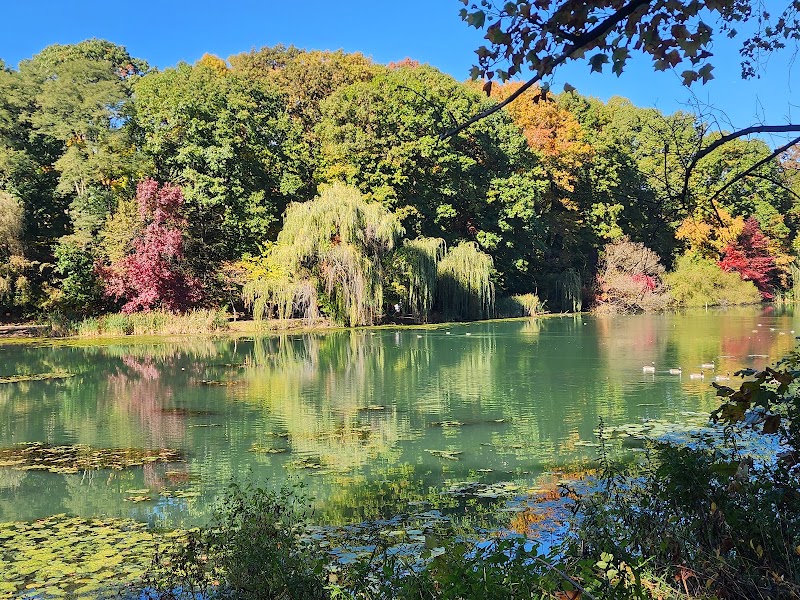
- The kettle ponds — Alley Pond, Little Alley Pond, Cattail Pond, Lily Pad Pond, Muskrat Pond, Turtle Pond and Windmill Pond, all of them depressions left by blocks of stranded glacial ice, plus Oakland Lake, a spring-fed kettle measured at about twenty feet deep in a 1969 study.
- The salt marsh and Alley Creek — the creek runs north into Little Neck Bay through restored intertidal marsh; fourteen acres were rebuilt in 1998 and an osprey platform put up at the same time was occupied the following spring.
- The Adventure Course — opened in 2007 and run by the Urban Park Rangers, with a climbing and bouldering wall, a zip line, high elements reaching up to about 45 feet, a trust-fall station, swings, nets and balance platforms.
- The old Vanderbilt Motor Parkway — William K. Vanderbilt II’s private toll motor road was converted into a bicycle path through the park that opened in 1938, and a two-and-a-half-mile stretch of that roadbed is still ridden today.
What you’ll find
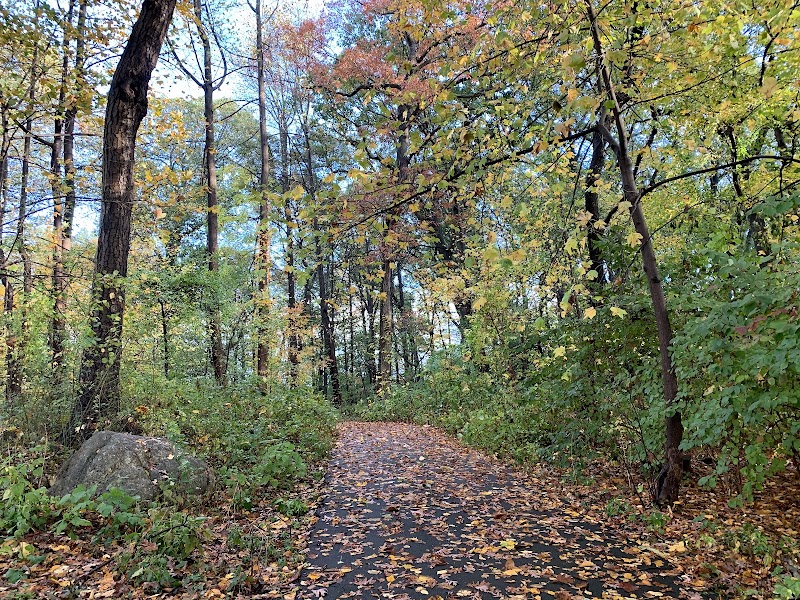
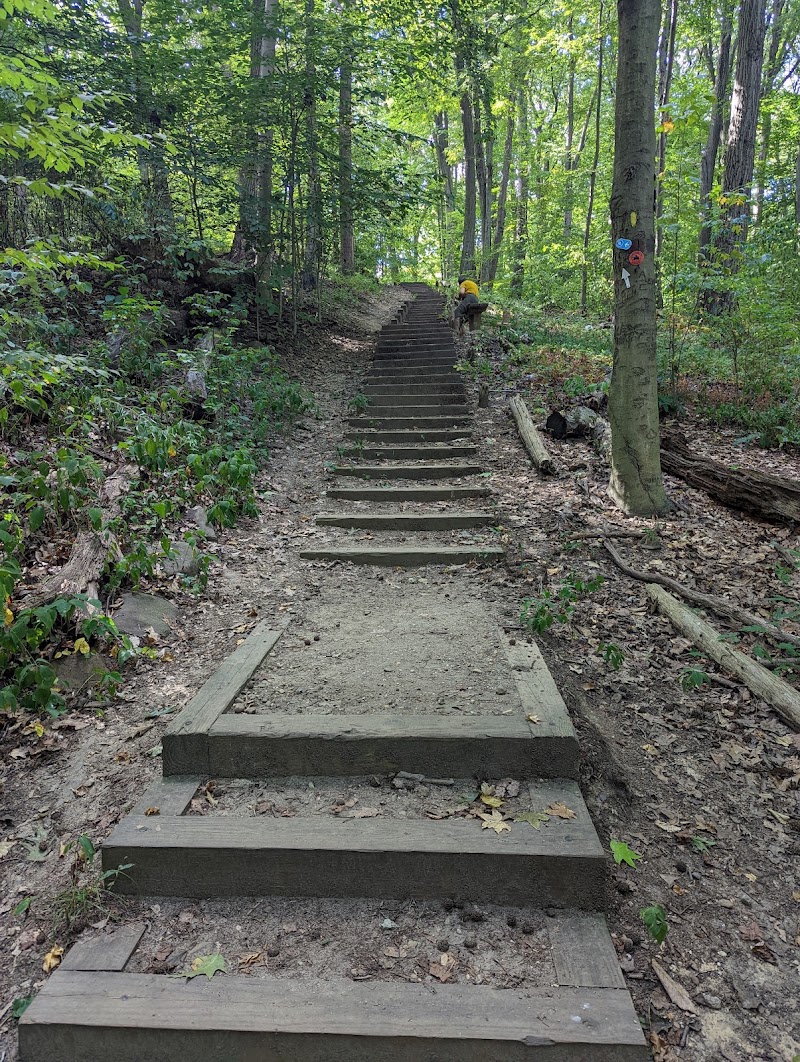
The park is essentially three landscapes stacked north to south: wetland and bay shore at the top, deep forest and ponds in the middle, and open recreation ground at the bottom. Six colour-coded trails — Red, Orange, Blue, White, Yellow and the Tulip Tree trail — run from about seven-tenths of a mile to a little over two miles each, and they connect into longer loops if you want them to.
- Around 530 acres of designated natural area, including old-growth-feeling forest along Alley Creek and one of the borough’s richest bird habitats.
- The John Riedl Wildflower Meadow, named in 1994, with ox-eye daisies, grey birch and pitch pine.
- A replica windmill completed in 2005, standing in for an 1870s Douglaston Manor windmill that was moved into the park and then destroyed by arson in 1988.
- A boardwalk loop at Oakland Lake, restored repeatedly — a million-dollar overhaul in 1987, further work in 2011 that also created the first bluebelt stormwater system in Queens.
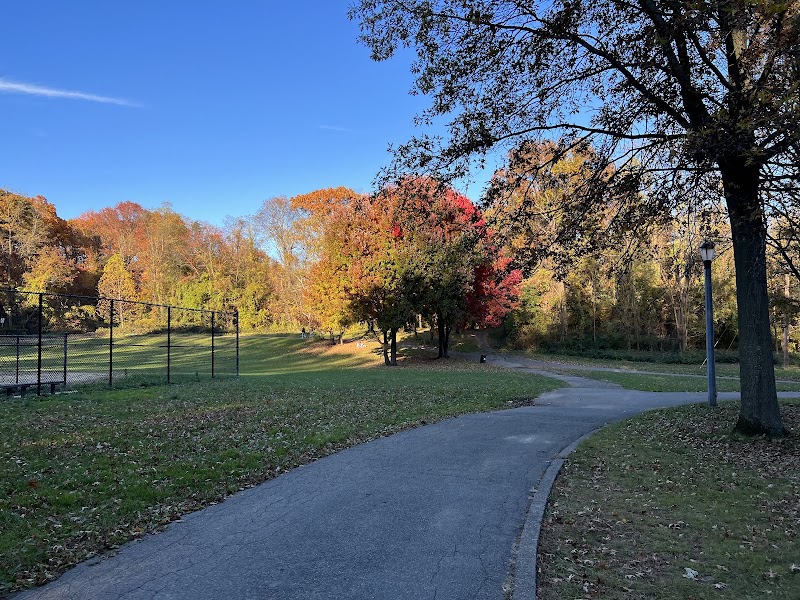
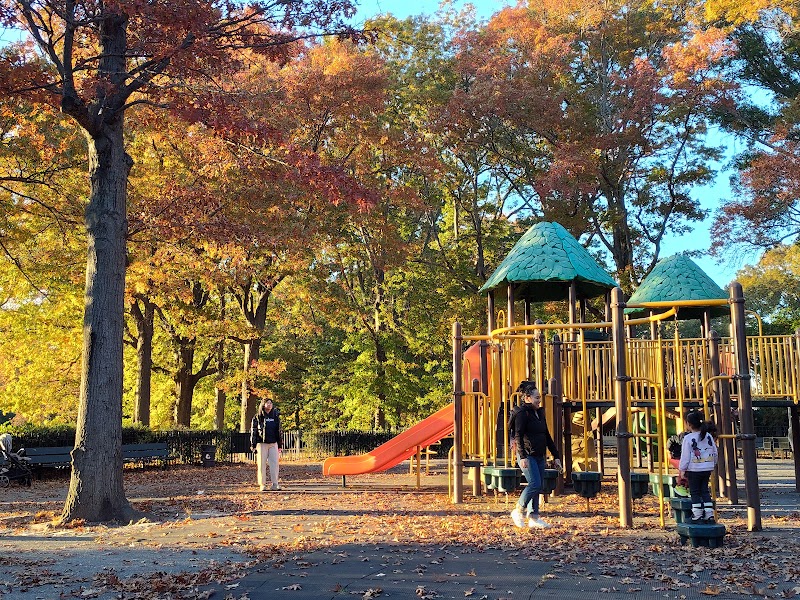
- Ballfields for baseball, soccer, football and cricket, plus basketball, handball and tennis courts, a golf driving range operating since the 1950s with dozens of stalls, and four playgrounds — Horatio, Alley, Alley Springfield and Alley Athletic.
- Joe Michaels Mile, the shoreline running and cycling path along Little Neck Bay linking the park toward Fort Totten, and connections into the Northeast Queens Greenway and the forty-mile Brooklyn–Queens Greenway.
Things to do — and who it’s for
- Hikers who want real trails — rooted, hilly, genuinely wooded paths, the closest thing to upstate walking inside the city limits, with enough length to build a two-hour loop.
- Birdwatchers — the combination of salt marsh, freshwater ponds, meadow and mature forest makes this a Queens hotspot; snowy egrets and osprey work the marsh, and spring and autumn migration brings warblers through the woods.
- Families and school groups — the Environmental Center is built for exactly this, with live animals, classrooms and guided programmes, and the playgrounds sit close to parking.
- Teenagers and team-builders — the Adventure Course offers free drop-in Sunday sessions in season for ages eight and up, first-come first-served, plus booked group programmes.
- Cyclists — the old motor-parkway bike path and the shoreline route give you flat, car-free miles that link onward across northeast Queens.
- Anglers and pond-watchers — Oakland Lake and the kettle ponds are quiet catch-and-release water with turtles, herons and, in winter, a rotating cast of ducks.
Getting there & practical
The park spans the neighbourhoods of Bayside, Douglaston, Oakland Gardens and Queens Village, which means the right approach depends entirely on which part you want. For the Environmental Center and the northern wetlands, the Q12 bus runs along the park’s northern edge, and the Long Island Rail Road’s Port Washington Branch stops at Douglaston and Little Neck within reach of the marsh and the bay path. For the southern recreation areas, take the E or F train to Union Turnpike–Kew Gardens and transfer to the Q46, or use the Q27, Q30, Q31, Q46 or Q88 depending on your entry point; Nassau’s N20 and N21 also serve the eastern edge. There is a parking lot of around two hundred spaces plus scattered smaller lots. Entry is free and the park keeps standard city park hours; the natural areas are effectively daylight-only in practice. The Environmental Center and the Adventure Course each run their own schedules — the Adventure Course’s free Sunday sessions operate from early summer into late October, weather permitting, and closed-toe shoes are required. Trails are unpaved, uneven and frequently muddy, so this is a proper-footwear park. Allow two to three hours for a decent walk, more if you are birding.
When to visit
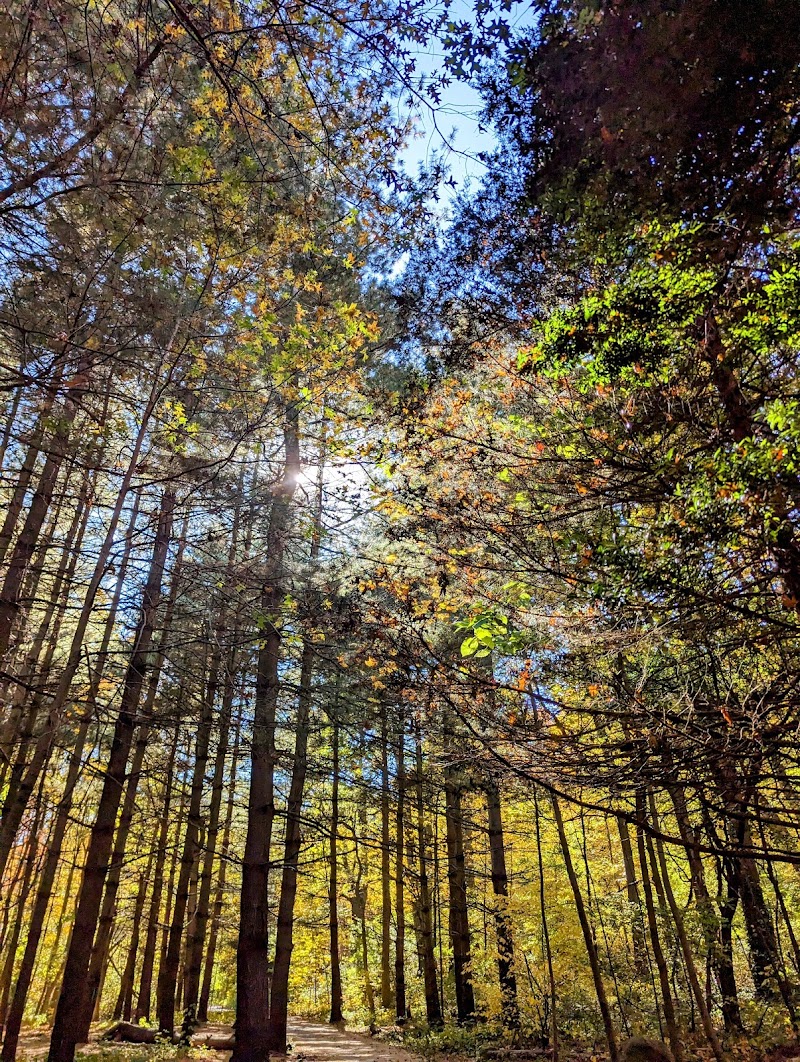
Spring is the strongest season: migrating warblers pour through the forest in late April and May, skunk cabbage and spring ephemerals come up in the wet hollows, and the marsh greens over. Summer is humid and heavily green — best early in the morning, when the ponds are still and the wetland is busiest with herons and egrets, and this is when the Adventure Course and the Environmental Center’s programming run at full strength. Autumn is the connoisseur’s choice: the tulip trees, oaks and hickories turn, fall migration is often more productive than spring, and the trails dry out. Winter is when the park’s geology becomes visible — leafless woods expose the glacial boulders and the shape of the kettle holes, waterfowl gather on Oakland Lake, and you can trace deer, fox and raccoon tracks in snow within sight of the parkways.
Good to know
The Board of Estimate authorised acquisition of the land in 1927; the city took the first Alley parcel on 24 June 1929 and added Oakland Lake in 1934, and the park was formally opened in 1935 with Mayor Fiorello La Guardia and Parks Commissioner Robert Moses in attendance. The “Alley” of the name refers to the narrow valley cut by Alley Creek, where a mill, a general store opened in 1828 by the Burhman family, and a small crossroads settlement once stood. The bicycle path along the old Vanderbilt Motor Parkway opened in 1938. The park spent the middle of the twentieth century being cut apart by highways — the Cross Island Parkway, the Long Island Expressway and the Grand Central Parkway all pass through — and the second half of it being stitched back together: a Wetlands Reclamation Project began in 1974, the first “Walk in the Alley” in 1969 drew two thousand people and helped build the constituency that saved the northern marshes, a million-dollar Oakland Lake restoration followed in 1987, the state designated the Oakland Lake wetlands in 1988, and a reconstruction of the parkway interchange between 2000 and 2005 reclaimed twelve acres and restored Alley Pond itself. The Alley Pond Environmental Center grew out of that same movement: founded in 1972 by Hy and Joan Rosner, it was serving well over sixty thousand students a year by 2011 with a small staff and about a thousand volunteers, and its long-awaited replacement building — seventeen years in planning, broken ground in 2020 — opened in October 2023. The Queens Giant, meanwhile, predates all of it: whether it is 350 or 450 years old, it was already a mature tree when the surrounding land was farmland and the Alley was a mill valley.
Visitor tips
- Treat this as a tick park. Long trousers, socks over cuffs, repellent and a check when you get home — the forest and meadow edges are exactly the habitat where they thrive from spring through autumn.
- Do not go hunting for the Queens Giant with a map you found online. Parks deliberately leaves it unmarked to keep foot traffic off its roots; if you want to see it, ask at the Environmental Center about guided walks instead.
- Start from the Environmental Center if it is your first visit. The Cattail Pond trail from there leads to an observation deck over Alley Creek and the wetlands, which is the fastest way to understand how the whole park fits together.
Questions & answers
How big is Alley Pond Park, and how does it rank? About 655 acres, which makes it the second-largest park in Queens after Flushing Meadows Corona Park, with roughly 530 of those acres managed as natural area.
Can I actually see the Queens Giant? The tree stands in a wooded section toward the northern end of the park, but NYC Parks does not sign or advertise its exact position, precisely because concentrated foot traffic compacts soil and damages roots. Guided walks are the responsible way to see it.
Is the Environmental Center free? The centre itself is a free public facility with exhibits and live animals; individual classes, camps and guided programmes are scheduled and some carry a charge. Opening days vary by season, so check before you travel.
How do I do the Adventure Course? Free Sunday drop-in sessions run in season for anyone aged eight and over, on a first-come first-served basis, and it is popular enough that arriving half an hour early is sensible. Closed-toe shoes are mandatory, adults need photo ID, and organised groups book separately.
Can I swim or fish? There is no swimming anywhere in the park. Fishing at Oakland Lake and the kettle ponds is catch-and-release, and a New York State freshwater fishing licence is required for anyone sixteen or over.
Are dogs allowed? Yes, on lead throughout, with the city’s designated off-leash areas and hours applying where they are posted. Keep dogs out of the restored marsh and off the pond edges, which are actively managed habitat.
Are the trails difficult? Moderate rather than hard. They are unpaved, root-crossed and hilly by New York standards, they hold water for a day or two after rain, and the colour blazes are not always obvious — take a photo of the trail map at the trailhead.
What wildlife will I realistically see? Egrets and herons in the marsh, osprey over Alley Creek in season, red-tailed hawks and woodpeckers year-round, turtles on the pond logs in summer, and — genuinely — deer, raccoon and fox sign in the quieter northern woods.
Can I cycle through the park? Yes. The paved path along the former Vanderbilt Motor Parkway roadbed and Joe Michaels Mile along Little Neck Bay give you car-free riding, and both plug into the wider Northeast Queens and Brooklyn–Queens greenway network.
Photos
Show 1 more photos
Visitor reviews
Reviews last updated: 2026-08-04 20:07:36
Data is refreshed monthly. Sources: queens.name and editorial picks based on reviews.
Стежка була дуже спокійною. По дорозі я бачив багато місцевих видів птахів, а також кількох білок і навіть єнота.
Гарні краєвиди, за парком дуже добре доглядають. Єдине, що хотілося б, щоб люди більше користувалися сміттєвими баками.
Я обожнюю ставок у провулку. Дуже тихі стежки (якщо ви поруч із шосе, то там не так тихо), доброзичливі люди та милі тварини, такі як білки, бурундуки. Я також бачив жаб та ропух раніше. Багато птахів та їхніх солодких п…
Я тут майже щодня, незалежно від погоди, зі своєю собакою для щоденних прогулянок та ігор. Ставок Еллі дуже чистий та привітний. Поля завжди доступні, стежки дуже зручні для людей будь-якого рівня. Стежки також мають кіл…
I grew up near this park over 50 years ago. I’ve only been back a couple of times since then. While visiting friends we went there to take a walk. We mostly followed the outermost trails and walked 3.5 miles. Parking on…